
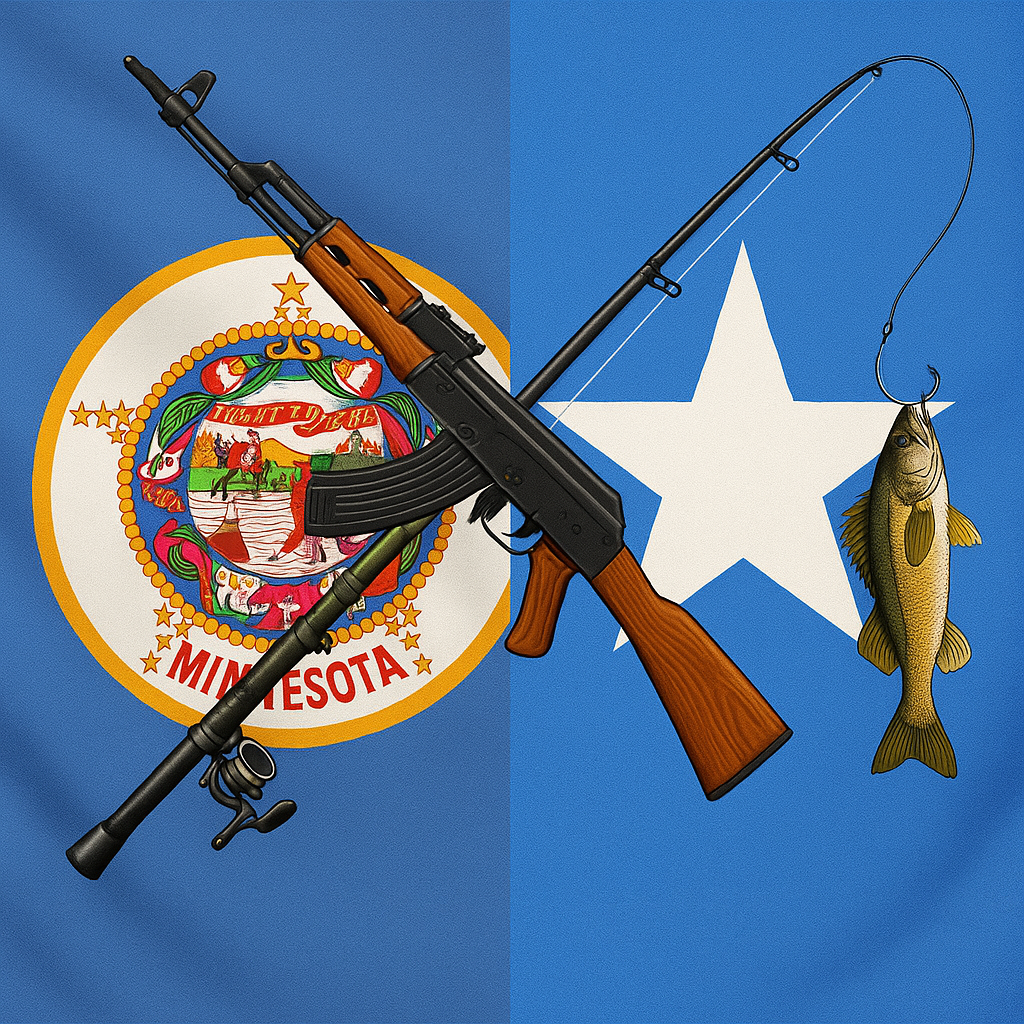
HOW MINNESOTA BECAME THE ATM OF A FAILING NATION
For thirty years, Minnesota told itself a comforting story.
It went like this: a war-torn country collapses; the United States opens its doors; refugees resettle in a welcoming state that prides itself on progressive governance, good schools, and generous social services. Over time, a traumatized community stabilizes, prospers, and becomes a success story.
That is one story.
There is another story, running underneath the press releases and multicultural brochures.
In that version, Minnesota’s welfare system quietly grows into a financial transfer machine: billions in subsidies and grants flow into a tightly networked diaspora community that sits at the mouth of a global remittance pipeline. Money moves from Minneapolis to Mogadishu not as charity, but as obligation — and every dollar that lands in Somalia’s war-scarred economy is touched, taxed, or skimmed by a government that cannot govern and an insurgent movement that behaves like a shadow state.
In that story, Minnesota doesn’t just help.
Minnesota pays.
And under Gov. Tim Walz, the state didn’t just fail to stop the leak; it defended the machine that kept it running.
A COUNTRY BUILT ON OTHER PEOPLE’S MONEY
To understand how Minnesota became an ATM, you have to start with Somalia — not as a cable-news talking point, but as a financial system.
Somalia has been a failed or semi-failed state for more than three decades. It has:
- a central government with weak territorial control,
- ministries openly implicated in corruption,
- no robust banking system,
- and an economy that survives largely on external inflows: foreign aid, NGO spending, and diaspora remittances.
If you removed external money from Somalia overnight, the government would collapse by the end of the week. That isn’t rhetoric; it’s arithmetic.
Into that vacuum sits hawala — the informal money transfer system that predates Western banks. When someone in Minneapolis sends $500 to a cousin in Hargeisa, it usually doesn’t go through Wells Fargo. It goes through a storefront hawala operator, who settles accounts with a partner in Somalia using a mixture of cash, trade goods, and ledger entries.
In principle, hawala is just fast, low-friction finance. In practice, in a place like Somalia, it becomes the nervous system of the entire country.
Every remittance:
- enters a clan-based patronage system,
- stabilizes families and neighborhoods,
- and, in areas under insurgent control, gets taxed by Al-Shabaab, which runs a parallel fiscal system with its own checkpoints, courts, and “customs” offices.
This is the part most American officials pretend not to understand: when money hits Somalia, someone gets paid for letting it move. It might be a customs officer, a warlord, a police captain, or a jihadist emir. But somebody eats.
So when an American state creates a large, leaky welfare system that disproportionately feeds into a single diaspora community tied to such an economy, it isn’t “aid” in the abstract.
It is off-budget foreign policy conducted by accident.
MINNESOTA: THE SOFT BELLY OF AMERICAN ADMINISTRATION
Minnesota did not design its programs for transnational corruption. It designed them for:
- speed,
- intake volume,
- and a political culture that equates skepticism with bigotry.
Over time, the state built:
- generous childcare subsidies,
- expansive food-aid programs,
- Medicaid reimbursements for a wide range of services,
- housing and development grants,
- and an enforcement posture calibrated not to avoid fraud, but to avoid headlines.
This would be risky under any circumstances. It becomes catastrophic when layered onto:
- a community with dense kinship networks,
- a cultural expectation of financial support for extended family abroad,
- and a homeland dependent on remittances.
Every system has an incentive structure. Minnesota’s said:
“If you can get the paperwork through, the money will flow — and we will be extremely reluctant to call you a liar in public.”
The result was not a handful of bad actors.
It was a fraud ecology.
- Daycare centers billing for children who never attended.
- Providers reporting 100% attendance on days they were closed.
- Autism therapy clinics billing Medicaid for sessions that never happened.
- Construction outfits inflating invoices under housing grants.
- Nonprofits acting as shells and pass-throughs.
And always, at the end of the chain: cash.
Some of that cash stayed in Minnesota.
Plenty did not.
FEEDING OUR FUTURE: SYMPTOM, NOT CAUSE
The public finally noticed when Feeding Our Future detonated.
Federal prosecutors alleged that a web of nonprofits and vendors stole roughly $250 million intended to feed low-income children, forging invoices for meals that were never served. It was one of the largest food-aid frauds in American history.
To normal people, it looked like a freakish one-off.
To anyone paying attention, it was a flare on a map that already had too many dots.
By the time Feeding Our Future blew up, Minnesota had already:
- documented childcare fraud in the tens of millions,
- wrestled with suspicious Medicaid billing patterns,
- seen warning signs in housing and development grants,
- and watched the same addresses and organizers pop up across multiple investigations.
The common pattern was obvious:
- Build a “community nonprofit.”
- Plug it into a state or federal program with weak oversight.
- Over-report services; under-deliver reality.
- Launder the excess through front companies or cash businesses.
- Send the surplus offshore through hawala and remittance channels.
Feeding Our Future wasn’t an anomaly. It was the first case too large for Gov. Tim Walz to shrug off.
Even then, he tried.
WALZ AND THE ART OF NOT KNOWING
Walz’s defense has always rested on one claim: he didn’t know.
Or, if he did know, he didn’t know enough early enough to act.
That line might work for people who never look deeper than a headline. It falls apart under even casual inspection.
When federal agents began eyeing Feeding Our Future, there were warnings, meetings, and communications between state agencies and federal counterparts. Local whistleblowers raised alarms about fraud in childcare subsidies and related programs. Journalists and watchdogs highlighted Minneapolis as a “fraud capital” where enforcement lagged incentives.
Walz’s response pattern looked like this:
- Minimize the problem as bureaucratic noise.
- Point to “business-friendly” incorporation and regulatory environments as proof Minnesota is open for opportunity.
- When federal indictments landed, insist the state was blindsided.
- Deny knowing about federal briefings that others insist occurred.
- Suggest that critics are unfairly targeting the Somali community for political reasons.
This is not ignorance.
It is political risk management.
Walz depends on a coalition where Somali-heavy urban districts, Somali political operatives, and Somali-run nonprofits are core components of the DFL machine. Calling out the scale of fraud in those networks would mean firing into his own command tent.
So he did what captured politicians do: he pretended the fire was a rumor until it burst through the ceiling.
THE FRAUD ECOLOGY AS A POLITICAL ACTOR
By the time Feeding Our Future became a household name, Minnesota’s corruption problem had evolved into its own political faction.
Not in the cartoonish sense of a “fraud party,” but in the more subtle sense of mutually dependent institutions:
- Nonprofits relying on public money.
- Political campaigns relying on nonprofits for turnout, messaging, and community contact.
- Legislative offices relying on diaspora leaders for mediation and credibility.
- Bureaucrats relying on political signals to know where “not to look too hard.”
In that environment, tightening oversight is treated not as a civic duty, but as an attack on “community leadership.”
This is how a welfare program becomes a constituency.
When fraud prosecutions finally come, the message isn’t: “We stole from the state.”
It becomes: “They are targeting our community.”
The faster that narrative spreads, the less likely future enforcement becomes — unless it comes from outside the state entirely.
Enter Somalia.
SOMALIA WEIGHS IN — AND TELLS ON ITSELF
What turned this from a domestic scandal into a geopolitical one was not the scale of fraud, but who decided to talk about it.
One of the loudest voices was Abdullahi Hashi Abib, a Somali Member of Parliament. In a string of public statements and letters, Abib:
- accused American writers and outlets of defaming Somalia and the Somali community in Minnesota,
- suggested that claims about welfare fraud and Al-Shabaab were politically motivated,
- and insisted that Somalia was being unfairly maligned.
But in the same breath, he admitted:
- Somalia’s government has a serious corruption problem,
- ministers steal foreign aid,
- the U.S. has opened active investigations into Somali officials and agencies,
- billions in external funds have vanished into private pockets,
- and he could not name the American agency involved because the investigation was ongoing.
He was trying to contradict the narrative.
Instead, he confirmed the architecture.
You don’t need a classified briefing to understand what this means:
- American money goes to Somalia.
- A significant portion is stolen by officials.
- U.S. investigators know it.
- Somali politicians are terrified it will become a public crisis.
When those same politicians rush to denounce reporting about Minnesota’s Somali-linked fraud rings, they’re not defending a diaspora’s honor.
They’re defending a revenue stream.
WHEN A TERROR GROUP STARTS DOING PR
The most extraordinary escalation came when Al-Shabaab itself reportedly issued a statement responding to claims that Minnesota welfare fraud had helped fund its operations.
Think about the level of entanglement required for that to happen.
A group that:
- runs insurgent campaigns,
- bombs hotels and government buildings,
- extorts businesses,
- and administers its own “courts” and customs posts
decided it needed to enter a narrative battle over American welfare policy.
You do not get that intervention if the underlying pipeline is imaginary.
It doesn’t matter whether Al-Shabaab insists the reporting is false. Their mere participation signals:
- they monitor diaspora politics,
- they view reputational attacks on money sources as operational threats,
- and they consider Minnesota’s flows significant enough to warrant public messaging.
Terror groups do not issue clarifications about things that don’t affect their budget.
TPS: WHEN DOMESTIC POLICY HITS A FOREIGN LEDGER
The Trump administration’s move to terminate Temporary Protected Status (TPS) for Somali nationals was framed domestically as an immigration and security issue.
In Somalia, it was received as something closer to a fiscal crisis.
TPS holders:
- are legal, work-authorized residents in the U.S.,
- can remain for long periods,
- and send money home with regularity.
That remitted income is not charity. It is:
- school fees,
- medical costs,
- housing,
- wedding expenses,
- and clan obligations.
When TPS is canceled, entire extended families in Somalia lose their predictable inflows.
So when Trump moved against TPS, what you saw was:
- Somali MPs denouncing the decision,
- ministries issuing protest statements,
- Somali media outlets amplifying the panic,
- and diaspora activists demanding reversal.
Again, notice the asymmetry:
- Minnesota politicos complained.
- Somalia’s political class panicked.
They were not losing “a symbol.”
They were losing what amounts to a line item in the national survival budget.
NATIONAL SECURITY: WHAT THE BRIEFING WOULD SAY
If you strip away the press releases and identity-politics theater, a sober national-security briefing on this situation would say something like this:
- Minnesota has, for decades, operated high-dollar welfare programs with weak enforcement.
- A significant share of fraud proceeds has flowed into a single diaspora-linked remittance system.
- Somalia’s economy relies disproportionately on those remittances.
- Somalia’s government is corrupt and under U.S. investigation for aid theft.
- Al-Shabaab taxes remittance flows and functions as a parallel revenue authority.
- Somali politicians and insurgents both reacted when the Minnesota fraud narrative hit critical mass.
- Gov. Tim Walz resisted acknowledging the structural problem because his political coalition includes networks close to the flows.
The conclusion wouldn’t be subtle: Minnesota’s administrative failures have produced foreign-policy consequences and national-security exposure, regardless of intent.
That doesn’t mean Walz is a foreign agent, or that every Somali nonprofit is a criminal enterprise, or that every remittance is dirty.
It means the system, as designed and defended, is incapable of distinguishing between:
- legitimate local need,
- diaspora support obligations,
- corrupt siphoning, and
- insurgent taxation.
That is what “fraud state” means in this context: a state whose controls are so compromised that it cannot reliably separate compassion from exploitation, or domestic policy from foreign consequences.
THE VERDICT ON WALZ
Tim Walz did not create the Somali diaspora.
He did not invent hawala.
He did not sit in a planning meeting and draw a pipeline from Minneapolis to Mogadishu on a whiteboard.
What he did do:
- inherit an already fragile system,
- oversee its expansion during his tenure,
- ignore or downplay multiple warning signs,
- deny or contradict evidence of federal engagement,
- lean on the very networks that benefitted from the leakage,
- and frame critics as bigots once the scandal hardened into public narrative.
That’s not bad luck.
That’s Level 3 negligence.
Leadership knowingly avoided action because enforcement conflicted with their political coalition, donor ecosystem, or base.
This is the highest level short of criminal intent in our framework.
It means:
- They saw the risks
- They knew the warnings
- They understood the structural problem
- And they still chose inaction because fixing it would cost political capital
This is what applied to Walz.
He wasn’t just unaware.
He wasn’t just incompetent.
He wasn’t just slow.
He was politically captured by the networks benefiting from the fraud ecosystem — meaning intervention risked fracturing the very coalition that kept him in office.
When a governor presides over a system that:
- hemorrhages public money on a historic scale,
- feeds an overseas economy known to be corrupt,
- intersects with terror-taxed financial corridors,
- and provokes reactions from foreign governments and insurgent groups alike,
you don’t get to say he “missed a memo.”
Walz’s failure was not just to protect Minnesota taxpayers.
It was to understand that, in a globalized, remittance-driven world, his refusal to enforce the rules at home would have consequences far beyond his own state.
Those consequences are here now.
And somewhere in Somalia, a hawala operator, a minister, and an Al-Shabaab tax collector have all noticed that Minnesota’s ATM is finally making the faint noise of an internal audit.
CITATIONS
- The Center Square – “Somali MP Responds to Claims of Minnesota Fraud and Al-Shabaab Funding” (2025)
- City Journal – “Minnesota Welfare Fraud: Some Funds Went to Al-Shabaab” (2025)
- Shabelle Media – “Fugitive Somali MP Abdullahi Hashi Abib Accused of Lies, Forgery and Faking Credentials to Mislead the Public” (2025)
- YouTube – Tucker Carlson Segment on Minnesota–Somalia Welfare and Remittance Flows (2025)
- U.S. Coverage of TPS and Somali Remittance Dependence (2025)
- Research Provided by @WarPig
Pingback: Tim Walz: Minnesota’s Gentleman Governor - #TCOT Reporter
Pingback: ilhan Omar: Pirate Queen - #TCOT Reporter
Pingback: Welfare Warlords Of The Somali Main - #TCOT Reporter
Pingback: Keith Ellison: The Interface Problem - #TCOT Reporter
Pingback: Ports, Factors, and Prize Agents - #TCOT Reporter
Pingback: A Sanctuary for Disorder - #TCOT Reporter