
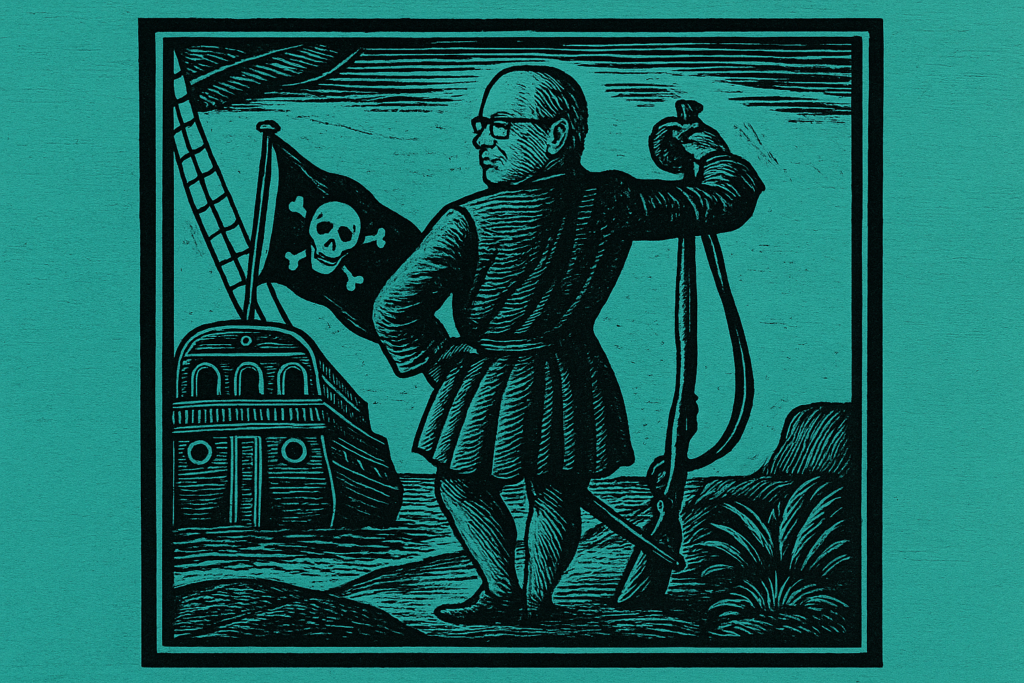
Tim Walz and the Pirate’s Life He Never Saw Coming
History is full of men who wandered into danger believing they were walking into opportunity. Most of them never knew the difference until the end arrived. Stede Bonnet — the delusional “Gentleman Pirate” of the early 1700s — is the archetype of this breed: a man who bought a ship, hired a crew, and declared himself a pirate captain without ever learning what a pirate was. His crew humored him. Real pirates used him. And when the British Navy finally cornered him, even the courts seemed embarrassed by the whole affair.
Three centuries later, Minnesota has its own Stede Bonnet.
“Walz governs like a man politely waiting for instructions.”— Star Tribune letter to the editor, 2023
Tim Walz was never a master strategist of the Democratic–Farmer–Labor machine. He wasn’t the architect of Minnesota’s multicultural experiments, nor the designer of the state’s sprawling web of nonprofit partnerships, diaspora outreach, or “equity-centered” welfare architecture. He was simply the man who stood there long enough — politely enough — for everyone else to build those systems around him.
He thought he was the captain.
He was the costume. Walz was never the operator. He was the ornamental figure at the bow.
And this week, as the Somali fraud story reached its national crescendo, the illusion finally collapsed.
A GOVERNOR OUT TO SEA
When Walz first entered statewide office, he carried himself like a man who believed Minnesota was fundamentally decent, and that decency alone could hold its institutions together. Auditors, inspectors, and internal watchdogs repeatedly flagged fraud in child-care grants, autism billing, food-distribution vouchers, housing allowances, and a dozen other programs. The red flags stacked up until they formed their own skyline. But Walz responded the way a schoolteacher addresses misbehavior: gently, with a hope that good intentions could outrun bad actors.
In the Stede Bonnet story, this is the moment Bonnet walked aboard his new sloop and cheerfully told his crew that piracy could be “civilized.”
We all know how that ended.
Minnesota’s emerging fraud ecosystem — built around clan networks, nonprofit empires, political intermediaries, and overseas remittance channels — didn’t respond to gentleness. It responded to vacuum. The softer the guardrails, the faster the fleets appeared. By the time the “Feeding Our Future” case exploded, Minnesota’s welfare state was less a system than a harbor: open-water access for anyone who knew how to navigate it.
Walz didn’t recognize the danger.
Bonnet didn’t recognize the ocean.
Neither understood the waters they were in.
A STATE HEADED BY A MAN NO LONGER IN COMMAND
The most telling part of this week’s revelations wasn’t the tape of Attorney General Keith Ellison quietly offering flexibility to fraud-adjacent political allies. It wasn’t the expanding estimates of the losses — now cresting past a billion dollars. It wasn’t even the sudden willingness of national media to admit the scope of the problem.
It was the mutiney.
More than 400 Minnesota social-service workers warned national Democrats that Walz bore direct responsibility for the state’s fraud epidemic — not because he designed it, but because he refused to confront it. Their letter was a bureaucratic cry for help: “We raised alarms,” they wrote in essence. “We were ignored.” They described political pressure to avoid certain audits. They described directives to temper enforcement. They described a climate where oversight was treated as an act of cultural insensitivity.
In pirate terms, the crew finally spoke the quiet part out loud: The captain isn’t steering the ship.
THE PIRATES WHO RAN THE PORT
In Bonnet’s story, real power rested with Edward Teach — Blackbeard — a man who understood that pirates aren’t managed; they’re navigated. He used Bonnet’s ship when it suited him. He used Bonnet’s legitimacy when it provided cover. He allowed the gentleman to believe he was part of the crew, even as he hollowed out the chain of command.
Minnesota’s version is an ensemble:
- Ellison, caught on tape speaking the quiet parts out loud.
- Ilhan Omar, framing scrutiny as prejudice while dismissing calls for accountability.
- Nonprofit figures who controlled vote blocks, turnout machinery, and grant pipelines.
- Political intermediaries who knew how to pull levers Walz pretended didn’t exist.
They weren’t following Walz.
They were functioning around him.
To everyone except Walz, this was obvious.
The gentleman governor was the only man who believed he held the wheel.
THE WEEK THE STORY BROKE OPEN
The past 48 hours have brought a series of overlapping shocks:
- Newly surfaced statements from workers saying Walz was “100% responsible” for the oversight failure.
- Reporting that hundred-million-dollar fraud estimates were deliberately minimized for electoral optics.
- Somali politicians abroad publicly accusing each other of forged documents, stolen identities, and coordination with Minnesota networks.
- The Ellison tape, quietly devastating.
- National media outlets publishing headlines they spent years avoiding.
- Editorial boards turning openly critical.
It is no longer possible — even for loyal Democrats — to dismiss the fraud as overblown. The scope is real, the networks are real, and the political protection behind them is undeniable.
“Ellison’s tapes make Minnesota look like a failed state.”— Washington Examiner, op-ed
“Political protection of criminals is now undeniable.”— City Journal contributor
“This is Tammany Hall with halal food.”— Free Beacon podcast
Walz is discovering what Bonnet learned when the Royal Navy finally gave chase:
When the tide turns, everyone who once benefited from your naivete steps gently aside and lets you take the fall.
A MAN WHO NEVER UNDERSTOOD HIS CREW
Bonnet’s tragedy is simple:
He wasn’t hated.
He wasn’t feared.
He wasn’t respected.
He was tolerated.
The same is true of Walz.
“Walz is becoming politically radioactive.”— National Review podcast
“DFL insiders want distance.”— Axios Twin Cities
While national Democrats once propped him up as a safe face for sensitive politics, the Somali political machine saw him as a useful shield, not a partner. The nonprofit class saw an amiable bureaucrat who wouldn’t ask difficult questions. Even his own staff viewed him as a figurehead they had to work around.
And now, when the state is finally reckoning with the consequences, Walz stands alone — the only man pretending he was ever in charge.
BONNET WAS HANGED FOR PIRACY UNDER FALSE PRETENSES.
WALZ’S PRETENSE WAS GOVERNANCE.
No governor should expect loyalty from networks that treat government as a funding stream. No politician should assume that communities organized around clan, remittance, and patronage structures will obey Western bureaucratic norms. And no leader should believe that institutional weakness can be disguised with teacherly optimism.
Minnesota’s collapse is not the story of a villain.
It is the story of a vacancy.
A vacancy at the top.
A vacancy in judgment.
A vacancy where courage was supposed to be.
Walz built neither the pirate fleet nor the harbor it sailed from.
But he stood at the bow long enough to convince himself he was the captain.
History has seen this kind of man before.
Stede Bonnet.
The gentleman who wanted adventure but didn’t want danger.
The leader who wanted the title but not the burden.
The captain who never realized he wasn’t the one steering the ship.
And in the end, that may be the greatest scandal of all.
Minnesota didn’t collapse because Walz was malicious.
It collapsed because Walz was vacant — a man politely waiting for instructions while the pirates charted the course.
Minnesota didn’t need a villain.
It needed a captain.
And it got Stede Bonnet.
SOURCES
- The Center Square – “Minnesota social-service workers say Walz responsible for fraud” (2025)
- City Journal – “Minnesota’s Somali Fraud State” (2025)
- American Experiment – “Keith Ellison caught on tape” (2025)
- New York Post – “Social-service workers blast Walz over $1B fraud” (2025)
- New York Post – “Walz’s woke refusal to call out Somali scammers cost billions” (2025)
- Shabelle Media – “Somali MP Abib accused of lies, forgery, and credential fraud” (2025)
- Star Tribune – Letter to the Editor (2023)
- Washington Examiner – Editorial remark on Ellison tape (2025)
- City Journal – Contributor commentary (2025)
- Free Beacon – Podcast segment (2024–2025)
- National Review – Podcast analysis (2025)
- Axios Twin Cities – Insider political notes (2025)
- Historical background — Stede Bonnet
Quotations and narrative details drawn from well-established historical summaries including:
Pingback: ilhan Omar: Pirate Queen - #TCOT Reporter
Pingback: Welfare Warlords Of The Somali Main - #TCOT Reporter
Pingback: Ports, Factors, and Prize Agents - #TCOT Reporter
Pingback: Keith Ellison: The Interface Problem - #TCOT Reporter
Pingback: A Sanctuary for Disorder - #TCOT Reporter