
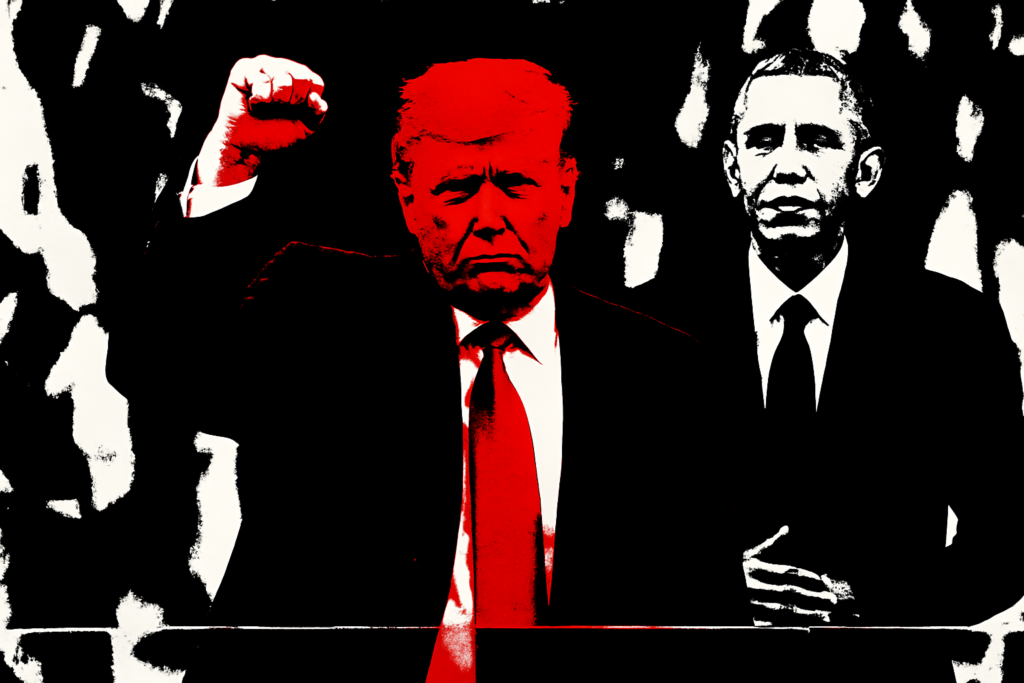
Even before Day One, the First Trump Presidency was sabotaged and the agenda hindered.
The day Donald Trump won the 2016 election, Washington revealed something about itself that had long been suspected but never so plainly expressed. The peaceful transfer of power—the civic ritual that Americans like to imagine is sacred—arrived not with the usual friction but with a stiffening of the institutional spine. A new president was coming in, but the old administration was not entirely leaving. The transition did not feel like a handoff; it felt like a warning.
Stories circulated among the incoming staff as soon as they stepped into the building. Some of them were small and petty in the way only Washington can be. A former press secretary later claimed that notes saying “You will fail” had been left in drawers by Obama staffers. Former Obama aides denied it so forcefully that the denial became its own story. But the literal truth mattered less than the atmosphere it captured. The new team believed the outgoing staff capable of something like that, and that belief revealed how charged the rooms felt. Transitions usually feel like moving into someone else’s house; this one felt like walking into a house where the previous occupants still had keys.
There were deeper signals as well. In those opening days, an internal memo circulated inside the new administration warning that Obama-aligned communications hands had built a sort of post-presidential echo chamber, an external pressure network capable of influencing or undermining the new administration’s foreign-policy messaging. Whether the memo overstated its own case was less significant than the fact that it resonated. When Ben Rhodes had once described shaping an “echo chamber” of friendly journalists and foreign-policy experts to sell the Iran deal, he had been bragging about an administration’s skill. After the 2016 election, that skill set became a structural advantage. The network he represented remained deeply embedded in the institutions that shape Washington reality, even outside office.
Intelligence briefings heightened the unease. What is supposed to be a protective shield for an incoming president instead felt like a spotlight. Years later, declassified material would suggest that certain FBI officials treated transition briefings as a chance to evaluate, rather than safeguard, the people about to take power. Combined with a rapid series of leaks that seemed perfectly timed to shape public perception before the new team even settled into their desks, the mood hardened further. The president-elect had not yet governed a single day, and the system around him had already begun reacting as if he were a threat to be managed.
This set the tone. Trump would enter office not as a principal inheriting a functioning machine, but as a foreign substance the machine intended to contain. From that point forward, his presidency did not unfold by normal rhythms. It unfolded like an autoimmune response.
In the weeks between the election and inauguration, the outlines of resistance took shape in ways that were subtle on the surface but unmistakable in their cumulative force. The intelligence community’s early Russia assessments, crafted in the fog of postelection scrutiny, were delivered into a media environment primed to interpret them as existential. Conversations inside senior Obama-era circles about how to “handle” the incoming administration were memorialized in unusual ways, including an email drafted on Inauguration Day itself describing a final Oval Office discussion about the limits and obligations of sharing intelligence with the successors. It was the sort of procedural record that only gets created when people know the next chapter will be contested.
At the same time, an accelerating tempo of leaks pushed into the press with a precision that suggested coordination even if no one ever admitted it. Revelations about intercepted communications involving incoming officials arrived in newspapers almost as quickly as those communications were collected. Questions about the president-elect’s legitimacy were not simply debated; they were laundered through official and semi-official channels, giving them the authority of the institutions that publicly insisted they were neutral. By the time the inauguration approached, the transition had become less a bridge and more a staging ground for four years of friction that everyone could already feel forming.
When the new administration finally took office, it discovered that the machinery of government was not passive. It had preferences, habits, loyalties, and a worldview that predated Trump and expected to outlast him. The intelligence community did not oppose him directly; it channeled his movements through narrow procedural corridors. Information surfaced in the press almost instantly, shaping narratives before any official could correct or contextualize them. Assessments that should have been internal became public weather reports, and internal disagreements crystallized into front-page headlines before the president even knew they existed. The IC’s power was not in its ability to strike; it was in its ability to define the atmosphere in which every political decision would be judged.
The bureaucracy behaved with a similar instinct for preservation. Agencies did not openly rebel, because they did not need to. They simply interpreted, delayed, revised, re-reviewed, and referred. Everything could be slowed just enough to dull its impact. A foreign-policy directive became a topic for interagency consultation. A regulatory change became a matter for prolonged guidance drafting. Personnel shifts became questions of HR protocol, clearance reviews, or compliance audits. Bureaucratic delay is the safest form of defiance because it looks like diligence.
The press amplified these dynamics with the urgency of a movement rather than the detachment of a profession. Leaks were not merely reported; they were elevated into serialized drama. Anonymous officials became fixtures of the national storyline, their claims treated as the dramatic counterpoint to a presidency they openly distrusted. Coverage was no longer about informing the public. It was about imposing a frame on the administration and treating every development, regardless of scale, as evidence of chaos, danger, or historical abnormality. Where previous presidents had endured critical press cycles, Trump endured a press architecture built to metabolize any action into narrative ammunition.
Outside government, NGOs, think tanks, activist networks, academic hubs, and digital-forensics groups formed a secondary shield—an ecosystem of actors who had built their identities during the Obama years and carried those identities into the Trump era with missionary zeal. They did not have formal authority, but they possessed cultural authority, and cultural authority in Washington can be more potent. They shaped which stories mattered, which experts were elevated, which foreign observations became domestic crises, and which interpretations of events were granted the aura of neutrality. Their role was not to govern but to validate the parts of government that opposed the administration from the inside.
The courts contributed their own form of resistance, not through sweeping rebukes but through the slow erosion of executive momentum. Injunctions turned into policy obstacles that were temporary in theory but permanent in effect. A policy can survive judicial review, but it cannot survive the loss of time. By the time challenges worked their way through the system, the political moment that made them urgent had passed. The judiciary did not strike down the presidency; it outwaited it.
Taken together, these forces created a presidency defined less by its actions than by the friction surrounding those actions. Trump was president in the constitutional sense, but not in the cultural or institutional sense. He possessed command authority but not operational authority. His administration lived inside a government that considered itself the real steward of continuity, and the people who staffed that government, trained under Obama and loyal to the worldview he constructed, behaved as if they were defending the republic from a populist tide they believed would eventually recede.
In the end, the Resistance Presidency did not defeat Trump. It outlasted him. It held its shape long enough for the system to return to what it considered normal. That normalcy was not democratic triumph; it was bureaucratic reversion. It was the victory of a worldview that claimed to transcend elections and a network that claimed to transcend presidencies. The Shadow President was not a hidden figure pulling strings in secret. It was the lingering imprint of the previous administration—the personnel, the ideology, the institutional muscle memory—running beneath the surface until the intruder left and the system could resume its preferred trajectory.
Trump stepped through the door of 1600 Pennsylvania Avenue expecting executive authority.
What he confronted was a bureaucracy with a different plan — one built around containment, not cooperation.
Within weeks of the transition, whispers turned into internal documents and leaks:
• A 2017 memo circulated inside the new White House, titled The Echo Chamber, warned that former aides from the previous administration constituted a “communications infrastructure … now being used to undermine President Trump’s foreign policy.” The memo listed ex-officials as “likely leadership” of a virtual war-room of sabotage.
• Days after inauguration, top intelligence officials briefed themselves on the incoming administration — a standard security procedure, but one that some later described as a pretext for gathering campaign-era intelligence under classified cover.
• In 2019, a former White House press secretary claimed, without evidence, that the prior administration had left notes reading “You will fail” in offices handed over to Trump staff — a vivid image that captured public attention.
That last claim was aggressively denied by multiple former aides, who pointed out that when they left, they left “words of encouragement.”
Whether those specific notes existed or not doesn’t matter. What matters is that — within days — the incoming president’s team believed they might, and that belief alone sparked alarm, disruption, and defensive recalibration. It offered them justification to treat every file, every office, every institution as suspect.
In short, the system blinked “unacceptable,” and administered a silent coup of procedure.
What followed was not governance — it was containment.
By any normal standard, Trump was president.
By the bureaucracy’s standard, he was a glitch to be managed until regular order was restored.
The Day the System Blinked “Unacceptable”
Presidents typically get a grace period: 100 days of optimism, handshakes, and neutral briefings. Trump got a leak.
The infamous “two-page memo” briefing Trump on the Steele dossier—delivered by James Comey—was less a courtesy and more a pretext. Its existence authorized the first leak of the dossier’s allegations to CNN. Its timing primed the media ecosystem for maximum damage. Its aftermath signaled to the bureaucracy that this presidency will not be treated as legitimate.
The permanent government decided immediately that Trump was anomalous data. And as with all anomalies, the system’s first response was containment.
⸻
The Elected President vs. The Permanent Government
Trump may have held the job title, but the bureaucracy held the tools.
The interagency immediately treated Trump’s priorities—immigration restrictions, intelligence reforms, foreign-policy shifts—not as instructions, but as disturbances. They responded like an immune system encountering foreign tissue:
• Slow them down
• Surround them with procedure
• Induce inflammation
• Localize the infection
• Wait until the host stabilizes
This wasn’t rebellion. It was institutional self-defense.
⸻
Intelligence as the Veto Power
The intelligence community did not oppose Trump with force; it opposed him with procedure. Assessments were selectively leaked to steer political narratives. Highly classified material surfaced in pieces that never appeared accidental. Foreign-intelligence reporting and internal debates were routed around the executive, feeding journalists and congressional committees in parallel while the president himself remained downstream of the story.
It opposed him with redactions, selective leaks, classified briefings, and parallel reporting channels.
• The ICA (Intelligence Community Assessment) treated political narratives as analytic conclusions.
• IC assessments were selectively leaked to steer political narratives.
• FISA warrants were extended via circular sourcing.
• Sensitive reporting was routed around the executive.
• Anonymous officials guided the press into prewritten narratives.
• Kislyak call spun into manufactured scandal.
• The Interagency became a shadow cabinet.
• Comey memos engineered to trigger a special counsel.
• Flynn neutralized by leaks.
General Mike Flynn’s takedown—within 23 days of inauguration—remains the purest example. A routine transitional call with a foreign ambassador was reframed as evidence of subversion. Leaked intercepts and insinuations, combined with bureaucratic sabotage, turned a mundane piece of statecraft into the ignition point for a scandal that pushed the incoming National Security Adviser out of office in a matter of days. A mechanism designed to understand foreign adversaries had been turned inward on the president’s own circle.
The effect was not just the destruction of one official. It was a signal to everyone watching: the system would decide which appointees counted. Not the president.
The Bureaucratic Firewall
Ben Rhodes famously called the Washington foreign-policy corps “the Blob.”
Under Trump, the Blob retaliated.
State Department careerists slow-walked directives, rewrote cables, and built internal networks of dissent. USAID contractors declined to pivot their overseas grant architecture even when priorities on paper supposedly changed. Pentagon officials developed their own informal channels with allies who were unsure whether to listen to the elected president or the permanent establishment. Everywhere, the pattern was the same. Orders were reframed as suggestions, suggestions were sent for review, reviews were stacked behind other business, and time did the work no explicit refusal had to do.
Every flame Trump lit was smothered by wet blankets made of:
• “interagency process,”
• “continuity concerns,”
• “chain-of-command norms,”
• and “interdepartmental review.”
Bureaucratic resistance never looked like someone standing up in a meeting and saying “no.” It looked like a room full of people nodding, taking notes, promising follow-up, and then quietly choosing not to hear.
⸻
The Media as the Resistance’s Public Affairs Office
The press didn’t resist Trump as an institution.
It resisted him as an identity.
The New York Times, Washington Post, CNN, and MSNBC shifted from watchdog to counter-administration, constructing parallel narratives across three-and-a-half years:
• “The walls are closing in.”
• “Bombshell report raises new questions.”
• “Sources say the president may have crossed a line.”
• “Legal experts fear the worst.”
These weren’t just headlines, nor were these neutral descriptions of events; they were pressure mechanisms, pulsing daily, ensuring that no policy victory or routine function could accumulate into legitimacy. Leaks became currency. Anonymous officials became celebrities. Every bureaucratic whisper became a three-alarm political fire.
The elected presidency spoke in one voice. The media ecosystem spoke in hundreds. The latter was louder.
⸻
The NGO-IC Fusion
Outside the formal channels of government, a new hybrid entity emerged: a non-governmental intelligence ecosystem. Think tanks, digital-forensics labs, counter-disinformation outfits, democracy-promotion NGOs, and academic centers came together around a shared project: defining Trump and his movement as a security problem.
Many of these organizations had cut their teeth on foreign campaigns: Russian interference, European populism, Middle Eastern conflicts. Under Trump, their focus slid from overseas to domestic targets. They built “risk matrices” for political speech, tracked adversarial networks online, and mapped the spread of narratives that cut against the preferences of the permanent class. Their job was to validate leaks, provide moral cover for bureaucratic resistance, frame the elected president as a danger, and translate internal preferences into a public story about defending democracy.
By the late Trump years, this NGO-IC fusion created a public-private intelligence structure that rivaled small nations in analytic capacity and influence. It made the bureaucracy feel it was not only correct but supported.
⸻
The Courts as Delaying Action
Judicial resistance did not arrive as one dramatic ruling; it arrived as a steady drizzle of injunctions and stays that soaked the administration’s agenda. Immigration orders, regulatory reversals, internal executive-branch restructuring, even foreign-policy directives were frozen in place by courts willing to treat campaign statements, supposed motive, or projected emotional impact as grounds for intervention.
If the bureaucracy was sand in the gears, the courts were concrete in the bearings. The calculation was simple. If an order could not be blocked outright, it could be delayed. Eighteen months of delay turns political capital into exhaustion. A policy that takes years to implement effectively never happens at all.
In this way, time—not statute—became the decisive enforcement mechanism.
⸻
Impeachment as Circuit Breaker
By 2019 and 2020, impeachment had drifted away from its original meaning. It became the system’s final tool of containment. Two impeachments in two years were less about removing Trump than about draining his political legitimacy and freezing the movement that brought him into power.
The first impeachment grew from bureaucratic dissent inside the national security apparatus. The second grew out of the aftermath of a protest that turned into a riot. Both were immediately framed not as political struggles but as morality plays. Impeachment, once a symbol of constitutional severity, became a sort of circuit breaker: a way to discharge political electricity before it overloaded the system.
⸻
The Shadow Presidency in Waiting
Throughout all of this, what might be called “Obama-world” remained the quiet center of gravity. Personnel pipelines flowed from, within and among the Obama campaign and White House alumni network, from OFA, WestExec, the Obama Foundation, and a thicket of progressive nonprofits into the national security council, the State Department, the Justice Department, the intelligence community, congressional committees, influential media outlets, and the NGO archipelago.
The result was simple and decisive: the worldview of the previous administration, not the current one, remained the default setting of American governance. Trump held the office. Obama’s ecosystem held the institutions.
That is the essence of the Shadow Presidency—not a dramatic hidden figure working strings in some smoky room, but a post-presidency that continues to govern through personnel, partnerships, narrative networks, and institutional reflex. It is the ability to maintain policy dominance even when formally out of power, because your people occupy the machinery.
⸻
I. The Opening Move: “Sabotage by Transition”
The first sign came in the handoff itself.
1. The “Echo Chamber” Memo – A Warning Document Ignored
During the early days of the Trump White House, staff circulated an internal memo alleging that Obama-era communications aides had established an informal network designed to undermine Trump’s foreign policy. The memo claimed a “communications infrastructure” was “now being used to undermine President Trump’s foreign policy.”
(Source: The New Yorker — “The Conspiracy Memo Aimed at Obama Aides…”)
Whether the memo was fully accurate or the product of a terrified early staff didn’t matter. The perception of sabotage became immediate reality.
2. The “You Will Fail” Notes Allegation
In 2019, former press secretary Stephanie Grisham told the Washington Post that Obama-era staff left taunting notes in desks such as “You will fail.”
(Source: Washington Post, Nov 19, 2019)
Former Obama staffers immediately countered, saying they left “words of encouragement” and accused the new team of fabricating the claim.
(WaPo, same article)
But again: the accuracy mattered less than what it revealed.
The incoming administration believed from day one that the bureaucracy had turned hostile—and behaved accordingly.
3. Intelligence Briefings Used as Surveillance?
Declassified records reviewed by Senate investigators suggested certain FBI personnel treated 2016–2017 intelligence briefings as an opportunity to collect information on Trump transition figures, including Flynn.
(Source: Grassley Senate Office release of declassified FBI briefing documents)
A briefing is supposed to protect the incoming executive.
This one monitored him.
4. Leaks Before the Oath
In the days immediately following Trump’s victory, the intelligence community leaked assessments and classified material to the press at a scale normally reserved for wartime disagreements.
CNN’s early airing of the Steele dossier—enabled in part by Comey’s now-famous “two-page” briefing—set the tone: the IC would treat Trump not as a principal, but as a subject.
⸻
II. THE TRANSITION SABOTAGE TIMELINE (2016–2017)
A documented, factual backbone of what the bureaucracy did before Trump even entered office.
Nov 9, 2016 — Day After Election
Multiple major agencies initiate “concern escalations” regarding Trump’s legitimacy.
Leaks begin immediately to CNN, NYT, WaPo.
Nov–Dec 2016 — IC Establishes Narrative Battlespace
CIA, DNI, and FBI circulate assessments on Russian interference with language later criticized for overconfidence, shaping media headlines for weeks.
Dec 2016 — Susan Rice Authorizes “Unmasking”
Rice and other senior Obama officials request dozens of intelligence unmaskings related to transition figures.
(Public reporting via Nunes/House Intel)**
Jan 5, 2017 — Oval Office “By the Book” Meeting
Obama, Biden, Comey, Rice, and Yates discuss how the incoming administration should be “handled.”
Rice memorializes the conversation in an unusual inauguration-day email to self.
(Source: Senate Judiciary, released 2020)
Jan 6, 2017 — Comey Briefs Trump on Steele Dossier
CNN publishes its infamous dossier story within hours.
The feedback loop between IC → press → public was fully operational.
Jan 20, 2017 — Inauguration Day
Counterintelligence personnel and IC liaisons continue monitoring transition figures.
January–February 2017 — Flynn Takedown
Leaked intercepts destroy Trump’s incoming National Security Advisor before he serves a month.
(WaPo received the leak; the leak itself was a felony.)
Early 2017 — The “Echo Chamber” Memo Surfaces
Trump staff circulate a memo warning Obama-aligned networks were acting as a shadow communication apparatus against the new administration.
⸻
What It Means
The Resistance Presidency was not a revolt.
It was a bureaucratic immune response.
The permanent government didn’t override democracy.
It corrected it.
The system decided the voters had made an error.
For four years, it managed that error through:
• leaks
• lawfare
• injunctions
• narratives
• bureaucratic inertia
• institutional loyalty to an ex-president
Taken together, these forces created a presidency defined less by its actions than by the friction surrounding those actions. Trump was president in the constitutional sense but not in the cultural or institutional sense. He possessed command authority without true operational authority. His administration lived inside a government that considered itself the real steward of continuity, and the people who staffed that government, trained and promoted under Obama and loyal to the worldview he constructed, behaved as if they were defending the republic from a wave they believed would eventually recede.
In the end, the Resistance Presidency did not defeat Trump outright. It outlasted him. It held its shape long enough for the system to return to what it considered normal. That normalcy was not democratic triumph. It was bureaucratic reversion—the victory of a worldview that claimed to transcend elections and a network that claimed to transcend presidencies.
The Shadow President, in this telling, was not a ghost. It was the lingering imprint of the previous administration—the personnel, the ideology, the institutional muscle memory—running beneath the surface until the intruder left and the system could resume its preferred trajectory.
Trump held office.
Obama’s networks held the government.
The Resistance Presidency is the hinge of the entire Shadow President series.
The Proxy Presidency will show what happens when a presidency is built specifically to cooperate with the permanent government—not confront it.
- The New Yorker – “The Conspiracy Memo Aimed at Obama Aides…” (June 2017)
- Washington Post – “Trump Press Secretary Faces Backlash Over Baseless Claim of ‘You Will Fail’ Notes” (Nov 2019)
- Sen. Grassley Release – “FBI Efforts to Co-opt Intel Briefings to Spy on 2016 Trump Campaign” (2020)
- Senate Intelligence Committee – Volume 5 Report (2020)
- Inspector General – FISA Abuse Report (2019)
- [House Oversight – Flynn Leak Background Materials] (Compilation)
- [Judiciary and multiple federal court filings related to injunctions, 2017–2020]
Pingback: The Migration of Narratives - #TCOT Reporter
Pingback: Auto-Pilot: The Proxy Presidency (2021–2024) - #TCOT Reporter