
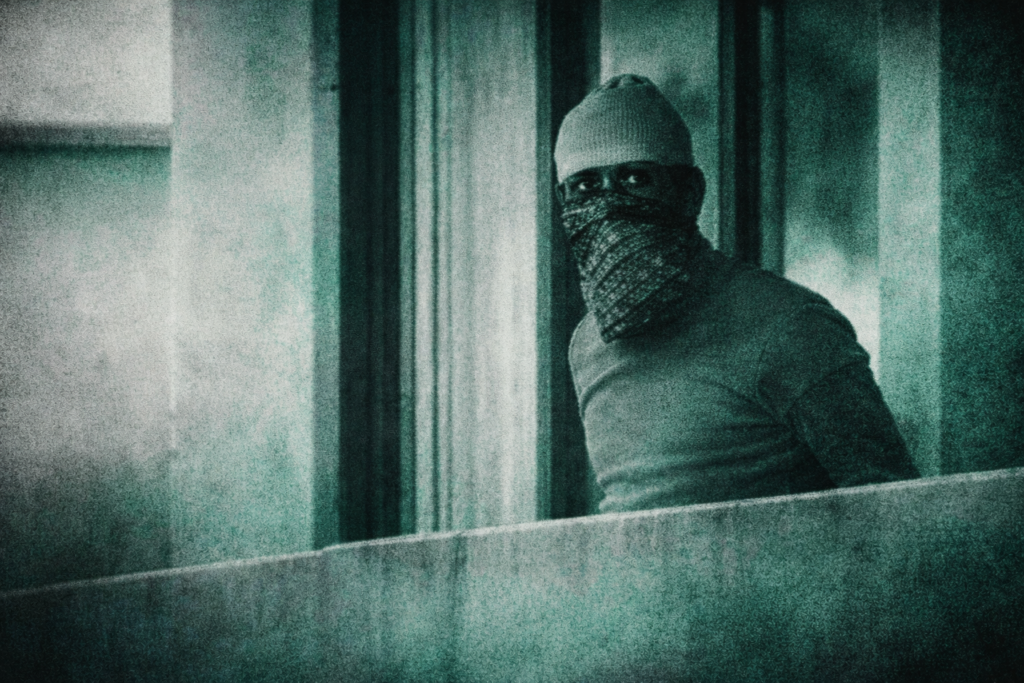
Munich Summer Olympic Games, 1972
The Munich Olympics were designed as an act of national self-correction. West Germany wanted distance from the memory of Berlin 1936, distance from spectacle harnessed to power, distance from the hard geometry of uniforms and force. The official language- “Happy Games” -emphasized openness, normalcy, lightness. Security was deliberately understated, almost performative in its restraint. Police wore pastel jackets. The Olympic Village had no meaningful perimeter. The absence of visible authority was meant to signal moral progress.
In the early hours of September 5, 1972, that aesthetic became a vulnerability.
Eight members of Black September, a Palestinian militant organization linked to the broader PLO ecosystem, climbed a low fence into the Olympic Village carrying duffel bags filled with rifles and grenades. They were mistaken for athletes by others returning from a night out and helped over the fence. Within minutes, the Israeli team’s quarters were under assault. Two Israelis were killed immediately. Nine others were taken hostage.
By mid-morning, the Olympics were no longer a sporting event. They were a live global broadcast.
What followed unfolded in plain view. Cameras captured masked gunmen on balconies. Negotiations occurred in real time, shaped as much by optics as by substance. German authorities, constrained legally from deploying military forces on domestic soil and lacking a specialized counterterrorism capability, improvised under the glare of worldwide attention. Tactical movements were visible not only to journalists, but to the attackers themselves via television coverage.
The attempted rescue at Fürstenfeldbruck airbase collapsed into chaos. All nine remaining Israeli hostages were killed. Five of the attackers died in the firefight. Three survived and were later released after a subsequent hijacking forced West Germany’s hand. The Olympic Games were suspended briefly, a memorial service was held, and then competition resumed.
The official framing emphasized tragedy and failure. The dominant narrative was logistical and procedural: insufficient preparation, inadequate coordination, poor tactical execution. Munich was treated as an aberration, a singular rupture in an otherwise orderly international system. The now-famous declaration that “the Games must go on” was widely received as defiance or resilience. In practice, it functioned as closure. The statement sealed the event off from deeper examination, allowing it to be mourned without being fully understood.
Munich is often misremembered through later lenses. It is sometimes folded into a generalized story of Islamist terrorism, despite the fact that Black September was not a religious movement and did not operate from a theological framework. Its language was secular, its objectives nationalist and revolutionary, its intellectual lineage rooted in the same Cold War Marxist-liberation politics that shaped militant movements across the globe in the 1960s and 1970s. Precision matters here. Munich was not the beginning of jihadist terrorism.
What it introduced was something more durable than ideology.
Munich demonstrated, at global scale, that violence conducted under continuous media exposure could generate power far in excess of the perpetrators’ material capabilities. The attack succeeded in imposing its terms on multiple governments not through force alone, but through visibility. Cameras did not merely document events; they structured them. Negotiation became theater. Time itself became a weapon. The presence of an audience altered the behavior of everyone involved, from officials to journalists to the attackers themselves.
West Germany’s hesitation was not only tactical. It was symbolic. The state was trapped between two fears: appearing incapable of protecting life, and appearing to revert to authoritarian reflexes in a setting explicitly designed to reject them. That tension played out in real time, with consequences that would echo far beyond Munich. Liberal restraint, unmanaged and untheorized, revealed itself as a liability when confronted by actors willing to exploit it as spectacle.
Just as importantly, Munich showed how grievance could be transformed into narrative leverage. The attackers’ demands were repeated, contextualized, debated, and reframed across global media, often detached from the immediate reality of hostages at gunpoint. Explanation and amplification moved faster than accountability. The structure of coverage encouraged audiences to process the event not only as an act of violence, but as a political argument performed through violence.
In the aftermath, governments responded where it was easiest to respond. West Germany created GSG 9, an elite counterterrorism unit. Israel formalized its global counterterror operations. Airport security hardened worldwide. These were tangible, technical fixes, aimed at preventing a recurrence of the same tactics in the same places.
What did not follow was a comparable reckoning with the informational dimension of the attack. No doctrine emerged to address the role of live media as an operational variable. No shared framework developed for handling hostage crises staged explicitly for broadcast. The lesson absorbed was procedural rather than conceptual. Munich was treated as a failure of execution, not as evidence of a new model of power.
That misreading matters because Munich was not an endpoint. It was a template.
Everything that follows in the modern history of terrorism borrows, in some form, from the Munich structure. Hijackings, embassy seizures, suicide bombings, mass-casualty attacks, and eventually digitally amplified atrocities all reflect the same underlying insight: in a mediated world, control of the narrative can rival or exceed control of territory. The attacker’s audience is never limited to the immediate victims. The true target is institutional behavior under observation.
Seen this way, Munich resembles a rehearsal more than an origin myth. Not because later actors shared Black September’s ideology—they did not—but because they learned the same lesson. Spectacle multiplies leverage. Language constrains response. Institutions bound by their own self-image can be maneuvered into paralysis.
The fence at Munich was low. The cameras were high. The world was watching.
The Games continued. The method did too.
Citations:
• BBC News – “Munich Olympics massacre: What happened in 1972?” (September 5, 2012)
• U.S. Department of State – Patterns of International Terrorism (Historical archives)
• Der Spiegel – “Munich 1972: The Terror Attack That Changed the Olympics”
• New York Times – Contemporary reporting on the Munich hostage crisis (September 1972 archive)
• Encyclopaedia Britannica – “Munich massacre”
• Encyclopaedia Britannica – “GSG 9” (formed in the wake of Munich 1972)