
For decades, American policymakers treated education as a domestic concern—local, fragmented, culturally neutral. Foreign influence was assumed to operate through embassies, lobbying firms, or intelligence services. That assumption is now obsolete.
The modern influence environment does not rely on persuasion after the fact. It relies on preloading authority—shaping what future journalists, analysts, bureaucrats, educators, and policymakers are taught before they ever reach positions of power. Curriculum has become infrastructure. And infrastructure, once laid, does not argue. It simply routes outcomes.
This is not a theory. It is a documented pattern.
From Soft Power to Structural Power
Foreign governments and aligned transnational NGOs have learned a simple lesson: it is far more effective to shape credentialing systems than to chase public opinion. If you can influence what is taught, who teaches it, and which interpretations receive institutional prestige, you do not need to win debates later. You define the boundaries of “serious” thought in advance.
In the United States, this strategy manifests through a layered ecosystem: K-12 instructional programs, university centers and endowed chairs, professional academic associations, peer-reviewed journals, and media narratives downstream of those institutions. Each layer appears independent. Together, they form a supply chain.
The funding does not arrive labeled as propaganda. It arrives as “education,” “exchange,” “diversity,” “research,” or “global engagement.” But the outputs are not neutral.
K-12: The Lowest-Friction Entry Point
The earliest insertion point is K-12 education, where oversight is weakest and curriculum transparency is often shielded by claims of pedagogical autonomy.
In December 2025, members of Congress sent a formal letter to New York Governor Kathy Hochul alleging that Qatar Foundation International had provided over $1 million to fund Arabic language teacher salaries and instructional materials in two Brooklyn public schools between 2017 and 2024. According to the letter, the New York City Department of Education declined to publicly release the curricula associated with that funding, citing internal review processes.
The same letter raised concerns about city-funded partnerships with outside groups accused of minimizing or contextualizing terrorist violence in professional development workshops, supported by more than $14 million in municipal funds since 2014. At the time of writing, state officials had not provided substantive public responses addressing curriculum content or donor influence.
Whether every allegation proves correct is not the central issue. The structure is. When foreign-linked organizations fund teachers, materials, and training while curricula remain undisclosed, education becomes a black box—and black boxes are ideal influence vehicles.
Higher Education: Where Influence Becomes Permanent
If K-12 programs introduce narratives, universities lock them in.
Federal law requires U.S. universities to disclose foreign gifts exceeding $250,000 under Section 117 of the Higher Education Act. The disclosures are incomplete, self-reported, and often opaque—but they remain the best official map available.
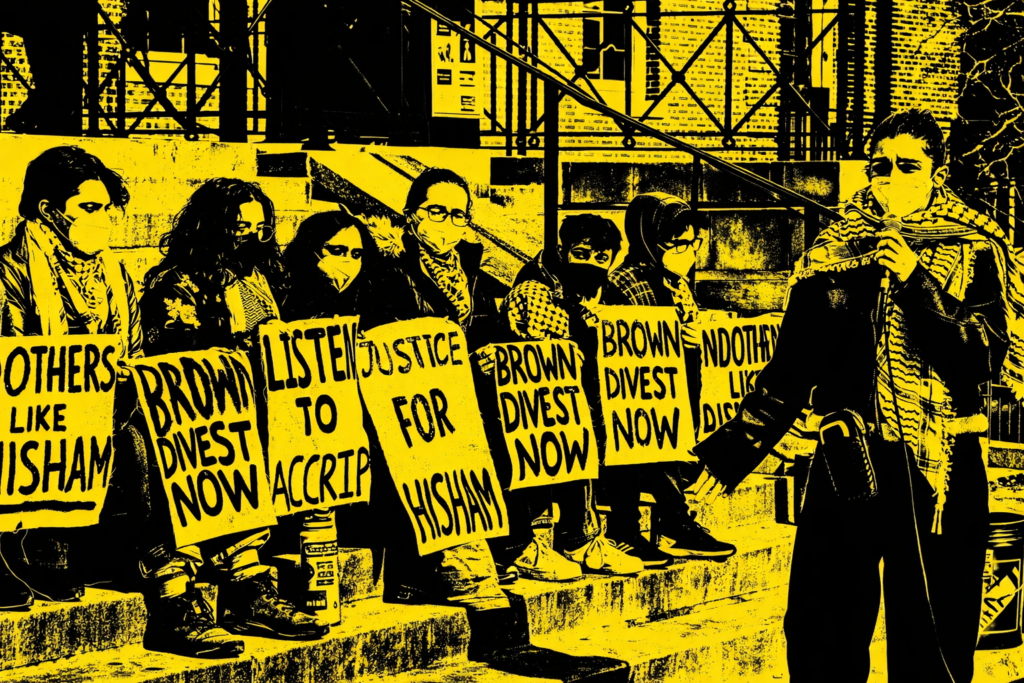
According to Section 117 data and secondary reviews, Brown University reported multiple restricted gifts from sources listed as “Palestinian Territories,” including two $643,000 donations in 2020 designated specifically for a professorship in Palestinian Studies. Additional restricted gifts under the same foreign source category total several million dollars across various years, supporting professorships, scholarships, and institutional programs. Aggregate figures cited in secondary analyses exceed $11 million over an indeterminate period.
Brown is not unique. It is illustrative.
Endowed chairs, once established, do not expire. They shape hiring priorities, research agendas, conference programming, graduate training, and publication pipelines for decades. The donor influence is not exercised daily; it is exercised structurally, through what becomes institutionally normal.
The most expansive case study to date involves Georgetown University, which has received over $1 billion in disclosed funding from Qatar-linked sources over time. A 2025 report by the Institute for the Study of Global Antisemitism and Policy documented how that funding intersected with governance structures, programming, and research output—not by dictating conclusions, but by shaping the ecosystem in which conclusions are produced.
Associations, Journals, and Hiring Signals
Universities do not operate in isolation. Academic legitimacy is mediated through professional associations, editorial boards, and conference circuits.
Organizations such as the Middle East Studies Association and the Association for Iranian Studies do not directly hire faculty. But they control the signaling mechanisms that determine who is visible, fundable, publishable, and promotable.
Journal editorial boards shape reputations. Conference invitations determine networks. Fellowship committees decide who advances. Over time, these mechanisms establish a dominant interpretive frame—one that future journalists, policy analysts, and government staffers absorb as baseline expertise.
This is how influence persists without enforcement. The system rewards alignment organically.
The NGO–IC Fusion
We have previously described the NGO–IC Fusion as the point at which intelligence-adjacent influence no longer requires overt state control. Instead, it is outsourced to civil society actors—foundations, nonprofits, academic institutions—that provide plausible deniability while maintaining strategic coherence.
Education is now one of its most effective theaters.
Once universities, associations, and curricula absorb aligned funding and norms, the state itself becomes a downstream consumer of outsourced narratives. Agencies hire graduates. Media outlets quote credentialed experts. Policy memos cite peer-reviewed work. No orders are issued. No coordination is required. The infrastructure does the work.
Media as the Downstream Multiplier
Journalism does not originate most foreign-policy narratives; it amplifies credentialed ones.
Reporters rely on academic experts, think-tank analysts, and institutional studies to frame stories. When those upstream sources share common funding environments and interpretive assumptions, media output converges naturally. This is not collusion. It is supply-chain logic.
We have seen this before. During the Cold War U.S. intelligence services understood that influencing journalists and academic institutions was more durable than influencing politicians. The same principle applies today—except the funding and messaging now arrive through formally independent channels (NGOs).
Why This Is a National Security Issue
This is not about silencing scholarship or banning foreign students. It is about recognizing that education systems shape state capacity.
When foreign-linked funding influences what future officials believe is legitimate, factual, or morally permissible, it affects policy outcomes without ever appearing on a ballot or briefing slide.
The danger is not indoctrination. It is normalization.
By the time these narratives reach public debate, they are no longer perceived as foreign positions. They are simply “what serious people think.”
The Question Policymakers Must Ask
The relevant question is no longer whether foreign money buys explicit control over teaching. The evidence shows influence rarely operates that crudely.
The real question is simpler and harder:
Who is financing the systems that decide what knowledge counts?
Until that question is answered transparently, curriculum will remain what it has quietly become—a foreign policy platform hidden in plain sight.
Sources:
- U.S. House Oversight Committee – “Letter to Hochul re: Malign Influence in NYC Schools” (Dec. 17, 2025) (PDF)
- U.S. Department of Education – Section 117 Foreign Gift and Contract Reporting: Data
- ISGAP – “FTM Georgetown Report” (PDF) (May 23, 2025)
- Middle East Forum / Campus Watch – “Qatar Foundation funding for US public schools”
- Daniel Pipes – “The Arabist and Islamist baggage of Arabic”
- Capital Research Center – “The Top Financiers of the U.S. Intifada”
- Capital Research Center – “When Charities Betray America”
- The Jerusalem Post – opinion piece you provided
- JNS – “Study doesn’t show Arab donations to universities cause antisemitism”
- Persian Heritage Foundation – official site
- Jerusalem Center for Foreign Affairs – “Hamas Has Two Godfathers…”
- Jerusalem Center for Foreign Affairs – “Da‘wa in Doha…”
Pingback: How Foreign Money Became Educational Infrastructure - #TCOT Reporter