
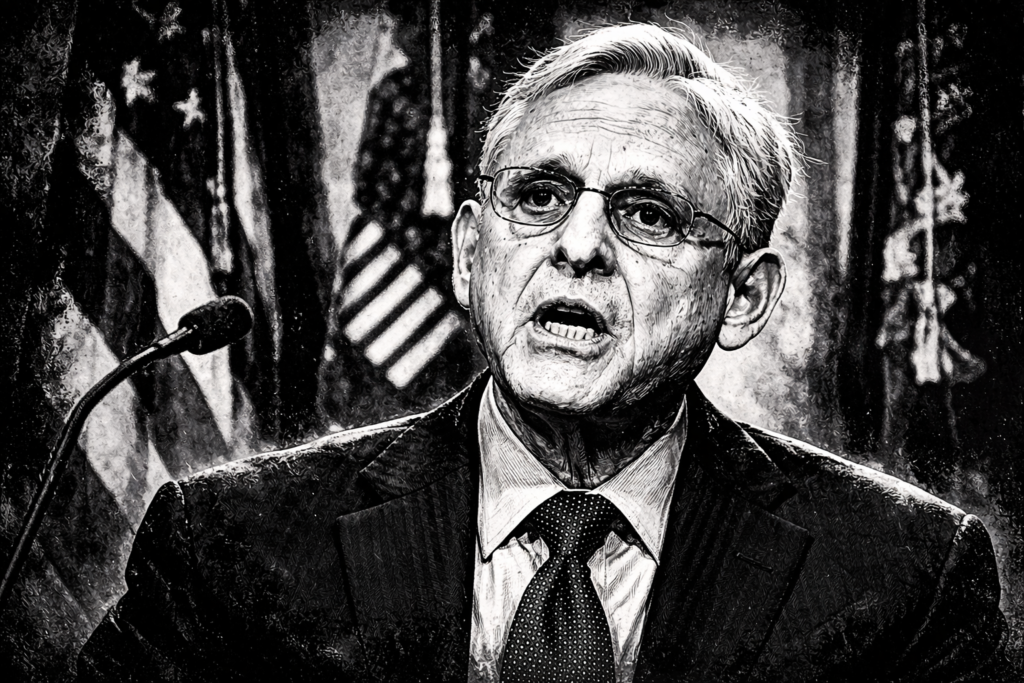
From the D.C. Circuit to a blocked Supreme Court nomination to the Justice Department’s most politically charged moment in decades, his defining trait has been restraint.
Merrick Garland has spent most of his adult life inside institutions that reward restraint, punish spectacle, and treat visibility as a liability. That path began long before his name became familiar to cable-news viewers or campaign lawyers. It began in the quieter corridors of the federal judiciary, where careers are built not by bold gestures but by demonstrating that nothing will break while you are in the room.
Garland’s early résumé reads like a catalog of credentialed seriousness. Harvard, clerkships, a steady rise through the Justice Department, and eventually a seat on the U.S. Court of Appeals for the D.C. Circuit. The D.C. Circuit is not just another appellate court; it is where administrative power, national security, and executive authority go to be translated into case law. Judges there are trained, implicitly, to think in terms of institutional consequences. Garland fit comfortably. His opinions were careful. His demeanor was unthreatening. He acquired a reputation as a jurist who would not surprise anyone.
That reputation became the core of his public identity in 2016, when Barack Obama nominated him to the Supreme Court following the death of Antonin Scalia. The nomination was framed as an olive branch, a gesture toward moderation in a polarized moment. Senate Republicans declined to consider it. Garland waited. The seat remained open. The election intervened. His nomination expired.
The episode is often remembered as a partisan rupture, but for Garland it was also a career inflection point. He emerged from it with heightened stature and a reinforced association with institutional patience. He had been denied elevation not for what he had done, but for what he represented: continuity without drama. That image would follow him.
When Joe Biden selected Garland as attorney general in late 2020, the country was still processing the aftermath of a contested election, widespread claims of fraud, and a riot at the Capitol. The Justice Department he inherited was politically radioactive. Career staff were wary. Republicans expected retribution. Democrats expected accountability. Garland promised neither. He promised process.
From the beginning, his approach was defined by what he did not rush. Investigations unfolded slowly. Charging decisions were delayed. Public statements were rare and deliberately narrow. Critics on the right saw selective enforcement. Critics on the left saw hesitation. Garland responded to neither group. The department would follow the facts. The department would speak through filings. The department would not be hurried.
This posture became most visible in the long arc of Trump-related investigations. While state prosecutors in New York and Georgia moved aggressively, the federal government appeared almost inert by comparison. The contrast was striking. Garland’s Justice Department allowed others to act first, absorbing the political shock while preserving federal distance. When congressional Democrats pressed for clarity, they received little. When Republicans accused him of politicization, he pointed to procedure.
Only in late 2022 did Garland appoint a special counsel to oversee investigations involving Donald Trump. By then, the political terrain had shifted. Midterm elections had passed. Multiple inquiries were already public. The appointment was framed as a safeguard, a way to insulate the department from accusations of bias. It also had the effect of inserting another layer between Garland and whatever came next.
That pattern repeated. Decisions were structured so that outcomes could be defended as inevitable products of independent processes. Authority was real, but it was rarely personalized. Responsibility diffused outward. Garland remained, at least publicly, above the fray.
Inside Washington, this style is not unusual. The Justice Department has long prized continuity and internal legitimacy over speed. What distinguished Garland was the degree to which his own biography aligned with that instinct. He had spent decades demonstrating that he could be trusted not to improvise. In a moment when improvisation carried extraordinary risk, that trust became his primary qualification.
The controversies that followed were therefore less about single actions than about accumulated timing. Search warrants executed after prolonged deliberation. Charging decisions that arrived after narratives had hardened. A department that moved last, but moved with confidence that the ground had already been prepared. Critics argued that delay weakened accountability. Supporters countered that restraint preserved credibility. Garland did not resolve the dispute. He simply proceeded.
There is a reason his tenure has proven resistant to scandal in the conventional sense. Garland rarely provides a clear hook. He does not tweet. He does not leak flamboyantly. He does not frame his own decisions as moral crusades. The effect is that criticism tends to slide off him and attach to those operating downstream. Prosecutors, judges, and investigators absorb the heat. Garland absorbs the continuity.
This has made him unusually durable. In a town where visibility often shortens careers, his low profile has extended his. The office he holds carries immense authority, but its most consequential decisions are often about when not to intervene. The salary is small; the leverage is not.
As of now, Garland remains what he has always been: a figure defined less by ideology than by position. His career tells a consistent story of advancement through trust, survival through restraint, and influence exercised indirectly. Whether history judges that approach as caution or abdication will depend on outcomes still unfolding. What is already clear is that his power has never depended on being seen using it.
That has been the point all along.
Sources:
• U.S. Department of Justice – “Attorney General Merrick B. Garland – Biography” (2025)
• New York Times – “Obama Chooses Merrick Garland for Supreme Court” (2016)
• Washington Post – “Why Republicans blocked Merrick Garland’s Supreme Court nomination” (2019)
• Department of Justice – “Attorney General Garland Appoints Special Counsel” (2022)
• Wall Street Journal – “Garland Names Special Counsel to Oversee Trump Investigations” (2022)
• New York Times – “Justice Dept. Faces Criticism Over Slow Pace of Trump Investigations” (2022)
• Associated Press – “Garland Defends Justice Department’s Independence” (2023)
• Reuters – “Timeline: DOJ investigations into Donald Trump” (2023)