
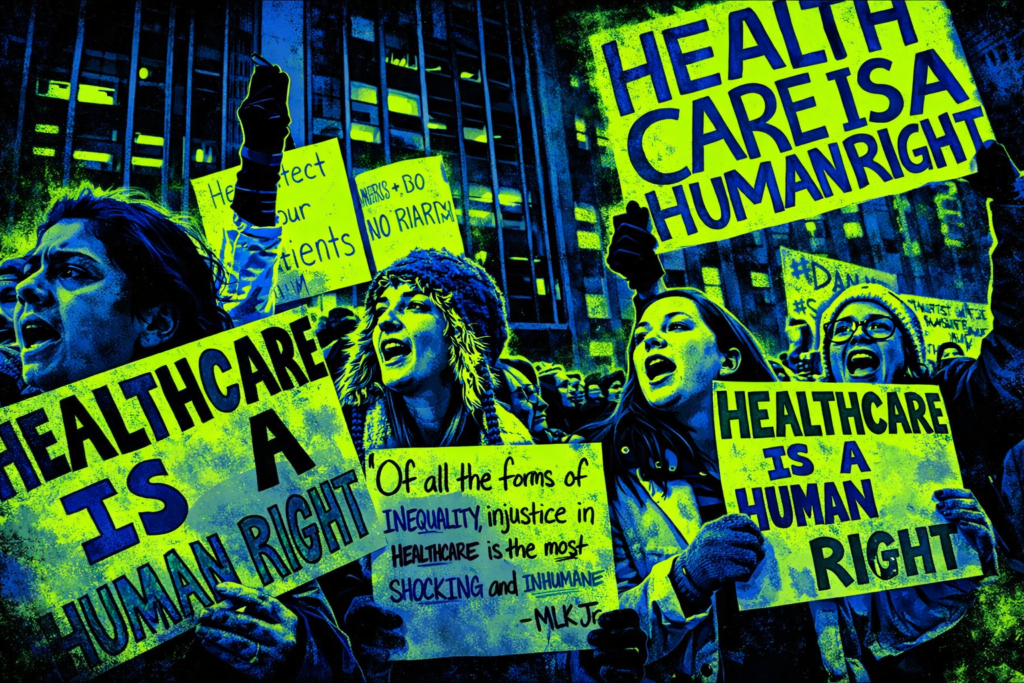
Obamacare promised “affordable care” the way a timeshare promises “vacation ownership”: lots of paperwork, surprise costs, and somehow you’re worse off at the end.
For more than a decade now, Americans across the political spectrum have agreed on at least one thing about the Affordable Care Act: it didn’t work the way it was promised.
Costs didn’t fall. Choices narrowed. Complexity exploded. Insurers consolidated. Employers adjusted around it instead of through it. Patients learned new bureaucratic dialects just to stay covered. Even its defenders eventually stopped describing it as elegant and settled for calling it “necessary.”
And yet, for a law that supposedly failed, it proved remarkably durable.
That durability is the clue.
Most postmortems treat ObamaCare as a flawed attempt at reform that ran aground on politics, math, or implementation. That framing assumes success was ever defined by affordability, efficiency, or consumer empowerment. But systems don’t persist this long, absorb this much criticism, and survive this many election cycles by accident. They persist because, at some level, they are doing exactly what they were designed to do.
The key was scale.
Once tens of millions of people were routed through exchanges, subsidies, mandates, and regulatory carve-outs, the program crossed a threshold where reversal stopped being a policy question and became a risk calculation. At that point, the argument shifted quietly but decisively—from whether the system worked to whether the country could tolerate the consequences of undoing it.
That’s when “broken” stopped being a liability and became a form of insulation.
From there, the mechanics followed a familiar pattern. Federal agencies gained permanent scope managing exceptions and compliance. Nonprofits, contractors, and advocacy groups professionalized around enrollment gaps, outreach, and enforcement friction. Private firms learned how to operate inside the rules rather than challenge them. Politicians discovered that overseeing the machinery generated more staying power than resolving the underlying problem ever could.
The value wasn’t in performance, but in how much of the population the system could route through it.
This is why every promised “fix” over the years has looked the same. Tweaks, extensions, temporary subsidies, emergency patches. Each one framed as urgent. Each one sold as compassion. Each one carefully calibrated to stabilize the structure rather than resolve the dependency it created. Real solutions would collapse entire ecosystems built to manage the shortfall, and no one inside those ecosystems is incentivized to pull that thread.
Even the recurring fights—like the current battles over extending COVID-era subsidies—follow the same script. The debate is never about whether the system should exist in its current form. It’s about whether any portion of the population should be allowed to exit it. The answer is always no, because once people are routed through a system at that scale, withdrawal becomes politically radioactive by design.
Critics on the Right spent years trying to defeat ObamaCare with better arguments and alternative plans, never fully grappling with the fact that they were contesting outcomes while the system was optimizing for permanence. You can’t dismantle a capture structure with a white paper. By the time the arguments were being heard, the architecture had already done its work.
Supporters on the Left didn’t need the law to function cleanly forever. They needed it to endure long enough to normalize reliance, embed administrative control points, and make future expansion the path of least resistance. Crises weren’t bugs in that process; they were renewal mechanisms.
Which is why the most telling feature of ObamaCare isn’t how often it’s described as broken, but how rarely anyone seriously proposes dismantling it anymore. Failure didn’t weaken the system. It stabilized it. Complexity didn’t undermine public support. It diffused responsibility. Dependency didn’t provoke backlash. It raised the cost of exit.
Once you see that pattern, it becomes difficult to unsee elsewhere.
When large systems persist despite obvious dysfunction, it’s usually because their real purpose isn’t what’s printed on the brochure. They aren’t built to solve problems cleanly. They’re built to manage them indefinitely, distributing access, risk, and dependence in ways that make reversal harder than continuation.
At that point, asking why nothing gets fixed misses the point.
The system is working exactly as intended.
SOURCES:
- U.S. Department of Health & Human Services – “Key Features of the Affordable Care Act” (2015)
- Congressional Budget Office – “Updated Estimates of the Effects of the Insurance Coverage Provisions of the Affordable Care Act” (2016)
- Centers for Medicare & Medicaid Services – “National Health Expenditure Data” (2010–2024)
- Kaiser Family Foundation – “Health Insurance Coverage of the Total Population” (2024)
- Government Accountability Office – “Affordable Care Act: Enrollment and Policy Changes” (2023)
- New York Times – “Why the Affordable Care Act Is So Hard to Change” (2017)
- The Atlantic – “The ACA Is Here to Stay” (2021)
- Brookings Institution – “Why Obamacare Survived” (2020)