
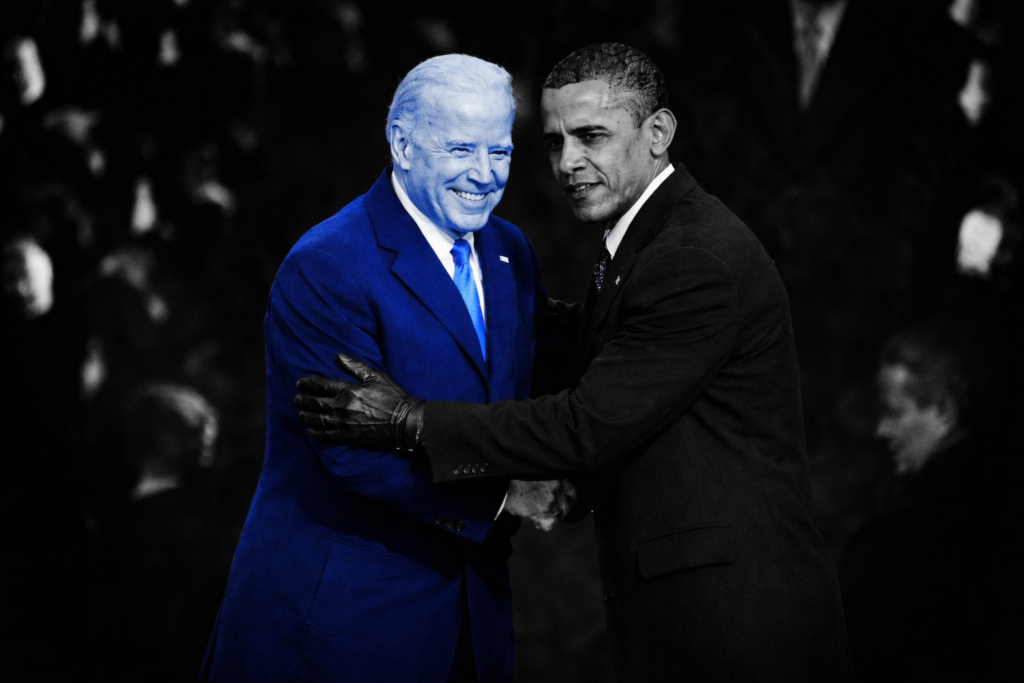
How Joe Biden ran such a detached, absentee administration without any real opposition or oversight, long before the average American became aware of his diminishing health and faculties.
In December 2020, during an appearance with Stephen Colbert, Barack Obama joked that the only way he would ever want to be president again would be if he could do it from his basement, with a phone, away from the daily spectacle of the office. The line landed as humor, but like most jokes that resonate, it worked because it sounded plausible. It described a version of executive power that no longer depended on visibility, stamina, or constant public engagement. Authority could be exercised indirectly, through alignment rather than command.
Within weeks of Joe Biden taking office, that model stopped feeling hypothetical. Long before the summer of 2024 forced the question into the open, there was a broadly shared public understanding that the White House was operating on something close to auto-pilot. This was not framed in medical or diagnostic terms at the time, nor was it especially partisan. The president was seen infrequently, press access was tightly rationed, schedules were thin, and extended stretches passed without unscripted engagement. Reports circulated that Biden worked limited daily hours. None of this produced sustained public controversy because it felt, oddly, unremarkable.
What stands out in retrospect is how little disagreement there was about these conditions among people who lived through them. Across political leanings, citizens quietly agreed on the basic facts even if they disagreed about their significance. Some interpreted the arrangement as responsible delegation, others as troubling opacity, but the underlying observation was shared. The presidency no longer functioned as a daily performance of authority. It functioned as a node inside a much larger system that appeared confident in its own momentum.
This is where analysis has to move beyond culture and personality. Power does not evaporate when a leader recedes from view; it relocates. When a government continues to operate smoothly despite the diminished visibility of its formal head, that is not evidence of weakness. It is evidence of alignment.
The contrast with the previous administration was immediate and instructive. During the Trump years, the permanent government behaved like an immune system confronting foreign tissue. Bureaucracy slowed, leaked, litigated, and resisted. Friction was constant because the presidency itself was treated as a disturbance. Under Biden, that friction vanished almost overnight. The same institutions that had strained against executive direction now moved with speed and confidence. The difference was not ideology alone; it was compatibility.
Personnel provided the clearest signal. Within months, familiar figures re-entered government from consulting firms, think tanks, NGOs, and academic centers that had served as holding pens during the years of resistance. The pipelines that had remained warm during Trump’s term suddenly ran in reverse, moving experienced hands back into agencies where institutional memory and shared worldview mattered more than innovation. This was not a purge or a coup. It was restoration.
Process accelerated accordingly. Interagency review, which had functioned as a brake during the previous administration, returned to its traditional role as a conveyor belt. Directives flowed outward without being softened into irrelevance. Grants, regulations, and foreign-policy positions moved with minimal internal friction because the people implementing them largely agreed with the direction of travel. What had looked like obstruction under Trump now revealed itself as discretion. The machinery had always been capable of speed; it simply chose when to use it.
The media environment adjusted in parallel. During the Resistance Presidency, leaks had been oxygen, feeding a daily sense of emergency and instability. Under Biden, the leak economy collapsed. Not because the press suddenly became deferential, but because there was less incentive to defect from inside the system. When institutional actors feel aligned with executive direction, they do not need anonymous intermediaries to shape outcomes. Coverage shifted from confrontation to reassurance, from exposé to normalization. Governance returned to background noise.
Courts followed the same pattern. The era of sweeping nationwide injunctions and aggressive judicial intervention faded as quickly as it had arisen. This was not because judges changed their philosophy, but because the system no longer experienced executive action as a threat requiring containment. Litigation still occurred, but it lost its role as a primary veto mechanism. Time stopped being weaponized because delay was no longer necessary.
Outside formal government, the NGO and think-tank ecosystem adjusted as well. During the Trump years, these organizations had functioned as external scaffolding for resistance, translating bureaucratic preferences into moral and analytical narratives for public consumption. Under Biden, their role shifted from opposition to reinforcement. They did not disappear; they harmonized. The same networks that once framed the presidency as a risk now framed it as stability itself.
All of this produced a presidency that felt quieter, calmer, and less dramatic than the one that preceded it. That calm was often interpreted as competence. In one sense, that interpretation was correct. The system works best, from its own perspective, when it does not have to fight the executive branch. But the deeper lesson of the Proxy Presidency is not about Biden’s personal qualities. It is about what modern American governance has become.
The presidency, under certain conditions, no longer needs to function as the engine of power. It can function as an interface. Decisions are shaped upstream, executed downstream, and justified laterally through media and civil-society networks that share a common language. The role of the president is to provide legitimacy and continuity, not disruption. In such a system, visibility is optional.
This is why Obama’s basement joke matters. It captured, unintentionally, a truth about how power prefers to operate in the current era. The most effective presidency, from the standpoint of the permanent government, is not one that commands attention but one that allows the machinery to run without interference. The Proxy Presidency demonstrated that such an arrangement is not only possible, but efficient.
Taken together, the Biden years reveal the inverse of the Resistance Presidency. Where Trump’s tenure exposed the system’s capacity for obstruction, Biden’s tenure revealed its capacity for seamless operation. The absence of conflict was not accidental. It was the result of alignment between the presidency and the institutions that actually move the state.
It’s truly fitting that the lasting image and legacy of Joe Biden’s Proxy Presidency will be the Auto-Pen, symbolic of an administration on auto-pilot with no single person as of yet known to have been responsible or accountable for the bulk of the Auto-Pen’s actions. In the end the only person who could and should be accountable- Joe Biden, the President whose name the Auto-Pen dutifully recreated as if a Soviet printing press birthing Rubles night and day in the basement of the Lubyanka, is now proven to have been of such limited faculties that it’s plausibly possible he had no knowledge whatsoever of what was being done at all.
This is the Shadow President in its most mature form. Not resistance, not sabotage, but continuity. Power exercised quietly, predictably, and with minimal visible input from the figure nominally at the top. The system did not need to correct this presidency. It recognized itself in it.
SOURCES:
Vanity Fair — “Reporters’ Frustration Is Building Over Lack of Biden Access” (March 8, 2021)
Axios — “Biden to hold first formal press conference next week” (March 16, 2021)
POLITICO — “NYT blasts Biden for avoiding interviews” (April 25, 2024)
Reuters — “US federal judiciary adopts policy to curtail ‘judge shopping’” (March 12, 2024)