
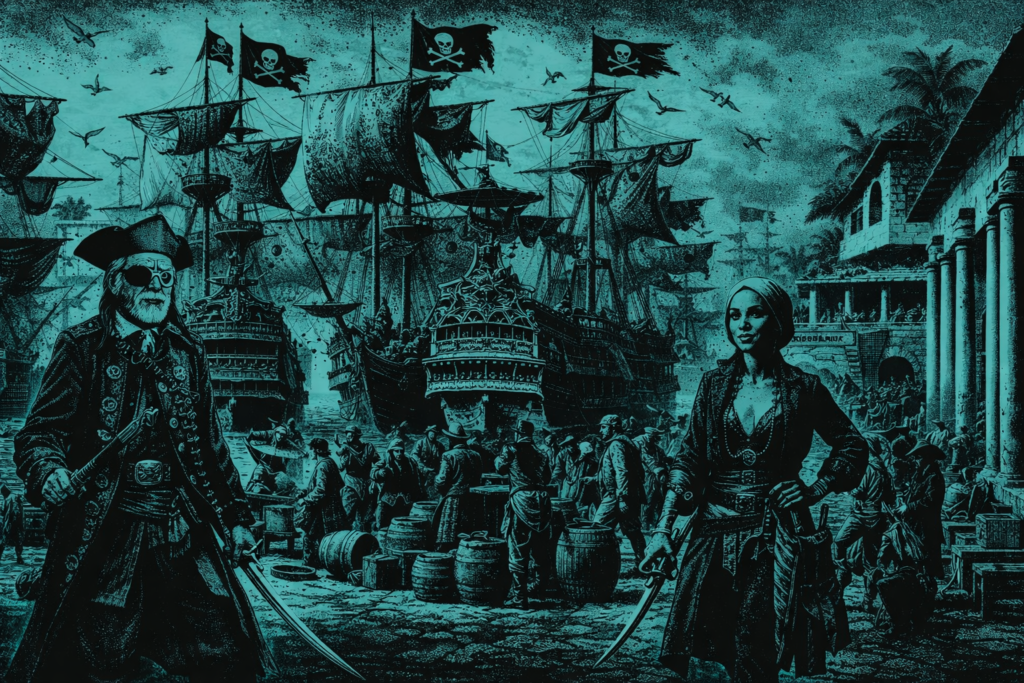
How the Modern NGO Economy Recreates the Infrastructure of Piracy
Piracy was never defeated by bravado or moral condemnation. It was defeated when governments finally understood that piracy was not a cultural pathology but a logistical one. The violence was visible, but it was never the core problem. The real engine of piracy lived on land, inside ports, warehouses, and offices where paperwork traveled faster than ships and accountability dissolved before it ever formed.
That historical mistake—focusing on the spectacle instead of the system—is being repeated today.
Modern America does not suffer from a shortage of laws, auditors, or enforcement agencies. What it suffers from is a sprawling intermediary economy that converts chaos into funding streams while insulating itself from consequence through complexity, moral language, and political protection. Nowhere has this been clearer than in Minnesota, where one fraud case after another has revealed not merely criminal actors, but an entire administrative environment that made abuse not just possible, but predictable.
This is not a story about villains. It is a story about infrastructure.
⸻
The Pirate Economy Was Administrative Before It Was Violent
During the so-called Golden Age of Piracy, pirates were dependent on systems that predated them and outlived them. A pirate ship could seize cargo, but it could not transform that cargo into wealth without intermediaries. That work was done by factors—commercial agents who handled resale, documentation, and laundering of legitimacy. It was enabled by ports that asked few questions and officials who preferred deniability to disruption.
Piracy collapsed only when those ports were closed and those intermediaries were punished. The violence diminished almost as a side effect.
The lesson is uncomfortable but obvious: when extraction becomes bureaucratically sustainable, it does not self-correct. It scales.
⸻
The NGO Economy and the Logic of Intermediation
The modern nonprofit and NGO ecosystem did not arise from malice. It arose from good intentions layered atop federal spending, emergency responses, and political coalitions. Over time, however, it has developed characteristics strikingly similar to historical prize economies.
Funds now move through chains so long and fragmented that responsibility becomes untraceable. Agencies award grants to fiscal sponsors, who distribute funds to nonprofits, who subcontract services, who hire vendors, who document compliance through self-reporting. Each layer exists to reduce risk, but collectively they eliminate ownership.
This structure does not require corruption to fail. It requires only incentives that reward scale, urgency, and moral signaling more than resolution or verification. In that environment, success is measured not by outcomes achieved but by money moved and crises sustained.
Minnesota’s recent fraud scandals did not occur in a vacuum. They occurred inside precisely this kind of system.
⸻
Minnesota as a Modern Port
The repeated discovery of massive fraud in Minnesota—spanning food programs, pandemic relief, and nonprofit contracting—has revealed something deeper than individual criminality. It has exposed a jurisdiction that functioned, unintentionally but effectively, as a modern port.
Warnings were raised. Irregularities were documented. Oversight agencies flagged concerns. Yet enforcement stalled, diffused, or deferred. Political leadership hesitated to disrupt coalition partners. Administrative agencies passed responsibility laterally. The result was not one failure, but a pattern.
Like pirate ports of the 18th century, the problem was not the absence of law. It was selective enforcement shaped by political risk and reputational fear. Once that equilibrium formed, exploitation did not merely occur—it concentrated.
⸻
NGOs and Cartels: Different Motives, Identical Logistics
Comparing NGOs to criminal cartels is provocative only if one confuses morality with mechanics. Ideology and intent differ radically. Logistics do not.
Cartels rely on intermediaries, jurisdictional fragmentation, and layered deniability. They move value through shell entities, exploit regulatory blind spots, and embed themselves within legitimate economies to mask extraction. NGOs, when poorly governed, can replicate the same pathways—not to traffic drugs, but to traffic public funds without accountability.
Both systems thrive where oversight is diffuse. Both resist reform by invoking humanitarian cost. Both collapse only when intermediaries are exposed rather than merely regulated.
The similarity is not ethical; it is architectural.
⸻
The Role of the Political Interface
In every piracy economy, the most dangerous figures were not pirates. They were officials who served as interfaces—individuals whose authority shielded systems from scrutiny while maintaining plausible distance from wrongdoing.
Contemporary reporting has raised serious concerns about whether political actors in Minnesota, such as State Attorney General Keith Ellison and Governor Tim Walz, functioned at times as protectors of coalition stability rather than enforcers of institutional integrity. Allegations that influence was offered, oversight discouraged, or enforcement delayed in exchange for political considerations do not need to be proven conspiracies to be damning. Their mere plausibility signals systemic decay.
When law becomes negotiable at the interface level, systems rot regardless of ideology.
⸻
Why Reform Keeps Failing
Oversight reforms repeatedly fail because they aim downward. They target recipients, tighten reporting requirements, and increase compliance paperwork. They almost never dismantle intermediary layers or realign incentives.
Piracy ended only when ports closed—not when sailors were scolded.
Similarly, NGO accountability will remain elusive so long as funding models reward perpetual crisis, political insulation, and moral exceptionalism. Transparency cannot fix incentives that punish enforcement.
⸻
The Real Risk
The greatest danger is not financial loss, though that loss is immense. It is reputational collapse. When citizens conclude that public money is administered through systems immune to scrutiny, faith in governance erodes. That erosion does not distinguish between good nonprofits and bad ones. It stains everything.
History is unforgiving here. Pirate economies collapsed not because they were immoral, but because they became intolerable to those funding them.
⸻
Conclusion: Close the Ports or Accept the Consequences
This is not an argument against charity, compassion, or civil society. It is an argument against systems that confuse intent with outcome and complexity with virtue.
Piracy ended when governments chose order over convenience and enforcement over optics. Modern governance faces the same choice.
If ports remain open, prize agents flourish.
If intermediaries remain untouchable, extraction continues.
And if accountability remains optional, legitimacy will not be.
Citations
- Department of Justice – “Feeding Our Future Fraud Scheme” (2022)
- Minnesota Office of the Legislative Auditor – Oversight Failures in Grant Programs (2023)
- City Journal – “How Minnesota Became a Magnet for Fraud” (2023)
- The Center Square – Minnesota Pandemic Fraud Investigations (2023–2025)
- U.S. Government Accountability Office – Improper Payments and Federal Grant Risk (2024)
- OECD – Public Governance and Intermediary Risk (2022)
- Council on Foreign Relations – Illicit Finance and Governance Weakness (2023)
- Library of Congress – Piracy, Prize Agents, and Port Economies (Historical reference)
Pingback: Keith Ellison: The Interface Problem - #TCOT Reporter
Pingback: A Sanctuary for Disorder - #TCOT Reporter