
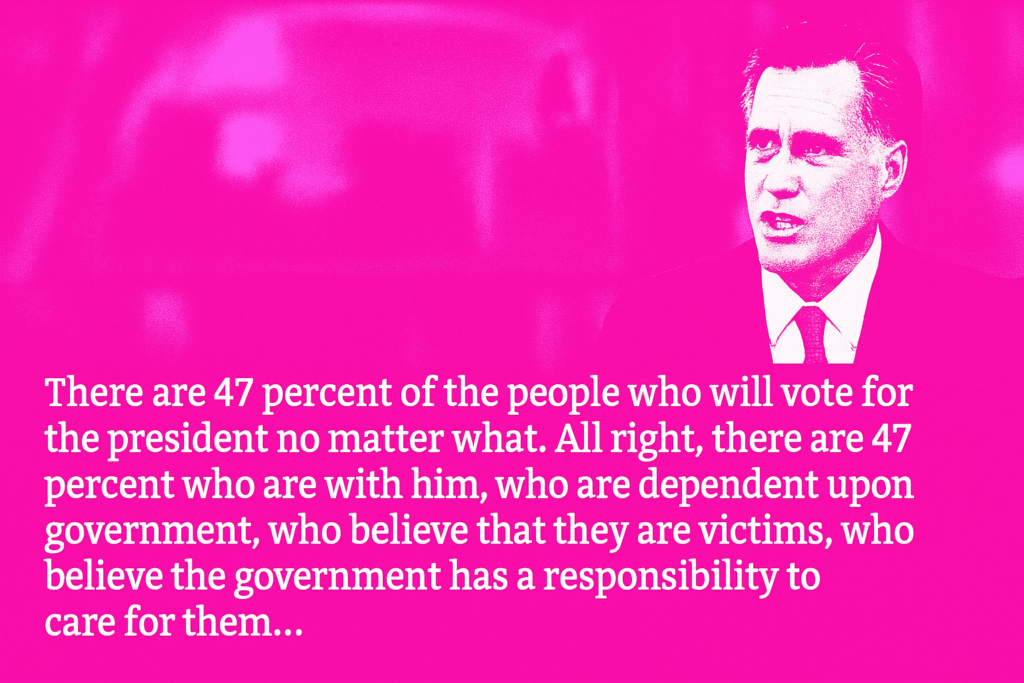
The 7% remark wasn’t a gaffe — it was a blueprint for why the old Republican model collapsed.
There are moments in American politics when a single sentence punctures a worldview.
For Republicans, the moment arrived privately, at a fundraiser in Boca Raton in 2012 — and detonated publicly days later — when Mitt Romney was recorded describing what he believed was the mathematical ceiling of his electoral coalition.
“There are 47 percent who… believe they are victims… who pay no income tax…”
That’s the line people remember.
But that isn’t the line that mattered.
The real shockwave came from the internal model behind the comment — the one his campaign lived by but never meant to say aloud:
Romney believed his persuadable universe was seven percent.
A sliver.
A margin.
A statistical niche where all strategy, messaging, and turnout rested.
Romney’s theory of America was not hateful.
It was technocratic.
He believed the country was divided into fixed customer segments:
- The left was immovable.
- The right was dependable.
- The persuadables — the elusive “practical middle” — were the only voters worth fighting for.
- And that middle was shrinking.
That interpretation produced a campaign built around deference, moderation, and managerial competence. A campaign that assumed the electorate was stable, calm, and fundamentally cautious. A campaign that believed persuasion required gentleness — not confrontation — because the 7% were imagined as delicate creatures who recoiled from conflict.
Romney didn’t lose because he misjudged Barack Obama’s appeal.
He lost because he mismeasured the country.
By 2012, the political marketplace had already mutated:
- Voters no longer believed in the old guard’s restraint.
- Institutions were losing legitimacy.
- The administrative state was flexing open muscle.
- Economic immobility had shredded the “pragmatic center.”
- Digital media had blown open the Overton window.
Romney misdiagnosed a real transformation as a statistical nuisance.
And when the 7% remark broke into public view, his campaign recoiled.
They apologized.
They clarified.
They retreated.
They tried to act as though a leak of a worldview could be treated like a gaffe.
It wasn’t.
It was exposure.
What Obama’s team understood — and what Romney’s team did not — is that the footage wasn’t damaging because of the words.
It was damaging because it revealed a campaign built on fear of the electorate, not partnership with it.
The Republican establishment had spent 20 years believing elections were won by courting suburban modesty while avoiding populist heat. Romney embodied that model so perfectly that the leak didn’t undermine his campaign — it revealed it.
And here’s the part that history books won’t capture, but insiders knew instantly: This was the first time the Republican base saw, in daylight, how little its own party believed in the people it claimed to represent.
The 7% remark did not lose Romney the election.
The campaign’s inability to fight back — to redefine, confront, or counterattack — did.
They absorbed the blow.
They believed the damage was irreversible.
They walked into the trap and allowed the narrative to calcify.
And in that void, something unexpected happened:
A certain New York businessman paid attention.
Not because he found the remark offensive, but because he found the surrender incomprehensible.
Where Romney saw an immovable electorate with a fragile middle, Trump saw an untapped majority of disaffected, ignored, and contemptuously miscategorized voters.
Where Romney saw seven percent, Trump saw sixty.
Where Romney apologized for a leaked worldview, Trump would later build campaigns on the explicit rejection of the same elite caution.
The 7% remark was not a scandal.
It was an autopsy — of a party philosophy that died while its practitioners were still defending it.
Romney believed the electorate was calcified.
Trump believed the electorate was volatile.
Only one of them understood the era.
And history followed accordingly.
SOURCES:
- Mother Jones – “Full Transcript of Mitt Romney’s ‘47 Percent’ Fundraiser Remarks” (2012)
- New York Times – “Romney Says 47% Comment Was ‘Completely Wrong’” (2012)
- Washington Post – “The real impact of Romney’s 47 percent video” (2012)
- Politico – “Romney on 47 percent: Not elegantly stated” (2012)
- CNN – “Secret video catches Romney remarks on 47% of Americans” (2012)
- Associated Press – “Analysis: Romney’s 47% remark reshaped the 2012 campaign” (2012)
- Gallup – “U.S. Party ID Stability and Voter Blocks, 2000–2012” (2013)
- Pew Research – “Electorate Polarization and the Shrinking Middle” (2012)
- BBC News – “The significance of Romney’s 47% remark” (2012)