
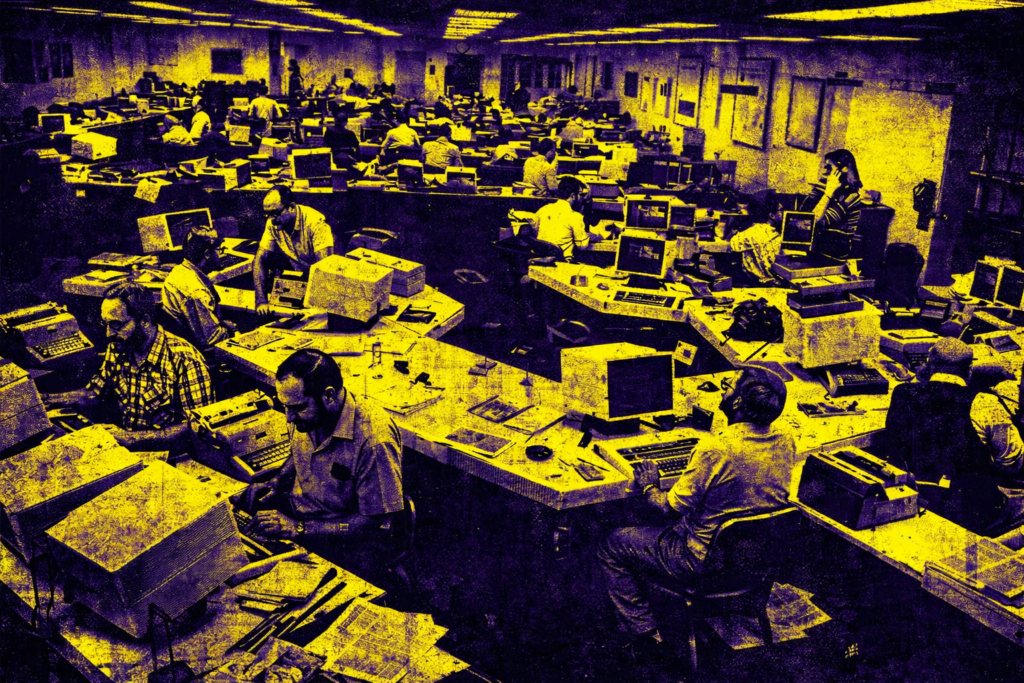
For most readers, journalism still appears as a straightforward transaction. A reporter notices something, verifies it, writes it up, and publishes. Disagreements happen downstream, but the origin story feels uncomplicated. That picture is no longer wrong so much as incomplete. The work still looks the same on the surface, but the path that brings people into newsrooms, and keeps them there, has quietly changed.
The modern journalism pipeline is no longer defined primarily by beats, editors, or even publications. It is defined by training programs, fellowships, credentialing pathways, and professional norms that operate upstream of the newsroom itself. These structures do not dictate outcomes or issue instructions. They shape what kinds of people advance, what kinds of risks are acceptable, and what kinds of questions feel worth asking before any editor weighs in.
This shift did not happen because reporters became less principled. It happened because journalism, like most institutions, adapted to a higher-risk environment. Shrinking revenues, collapsing local newsrooms, legal exposure, and reputational volatility forced the profession to professionalize its entry points. What emerged was not censorship, but selection.
Early-career journalists today are far more likely to pass through formalized programs than their predecessors were. Fellowships, nonprofit-backed training initiatives, university-affiliated centers, and grant-funded reporting projects increasingly serve as the on-ramps. These programs teach technical skills, but they also teach norms: how to frame responsibly, how to avoid reputational hazards, how to stay within professional guardrails that are rarely written down but quickly understood.
None of this requires explicit pressure. The incentives are enough. Opportunities flow toward those who demonstrate reliability within the system, and reliability is defined less by ideology than by judgment. Judgment, in turn, is shaped by what the surrounding environment rewards. A journalist who consistently creates problems for institutions that provide access, funding, or legitimacy will find future options narrowing, even if no one ever says so out loud.
This is where the idea of independence becomes more procedural than positional. Independence is no longer simply a matter of not taking orders. It is a matter of navigating a dense web of professional expectations while preserving one’s ability to continue working. A reporter can be sincere, diligent, and factually accurate while still internalizing constraints that make certain lines of inquiry feel impractical or unnecessary.
The effect is subtle but cumulative. Over time, reporters learn not only what they can publish, but what is likely to go anywhere. Stories that fit established categories move smoothly through the system. Stories that challenge those categories require more justification, more sourcing, more time, and often more risk. Faced with constant deadlines and limited institutional support, most people adapt rationally.
What makes this system durable is that it does not rely on coordination. Each participant is acting independently, responding to signals that are structural rather than personal. Training programs emphasize best practices. Editors emphasize responsibility. Funders emphasize impact and sustainability. None of these goals are sinister, but together they shape a professional environment in which alignment emerges without instruction.
The result is a pipeline that produces remarkably consistent outputs across outlets that are otherwise competing with one another. Language converges. Frames repeat. Certain topics receive intense scrutiny while others remain peripheral. This is not because journalists are told what to think, but because the system rewards those who think in ways that travel well within it.
Political power has learned to recognize this. Formal office still matters, but the real advantage lies in occupying positions that influence how issues are framed before they ever reach a vote. The salary is small; the leverage is not.
Understanding this pipeline does not require cynicism about individual reporters. It requires taking institutions seriously as systems that respond to incentives. Journalism still performs essential work, but the conditions under which it operates have changed. Seeing the pipeline clearly does not diminish the profession. It explains why it behaves the way it does.
SOURCES:
- Nieman Lab – “The rise of journalism fellowships and what they mean for newsrooms” (2023)
- Columbia Journalism Review – “How nonprofit funding reshaped American journalism” (2022)
- Pew Research Center – “State of the News Media” (2024)
- ProPublica – “How grant-funded journalism works” (2021)
- Knight Foundation – “The future of local journalism” (2023)