
How Section 117 Turned Foreign Influence Into Background Noise
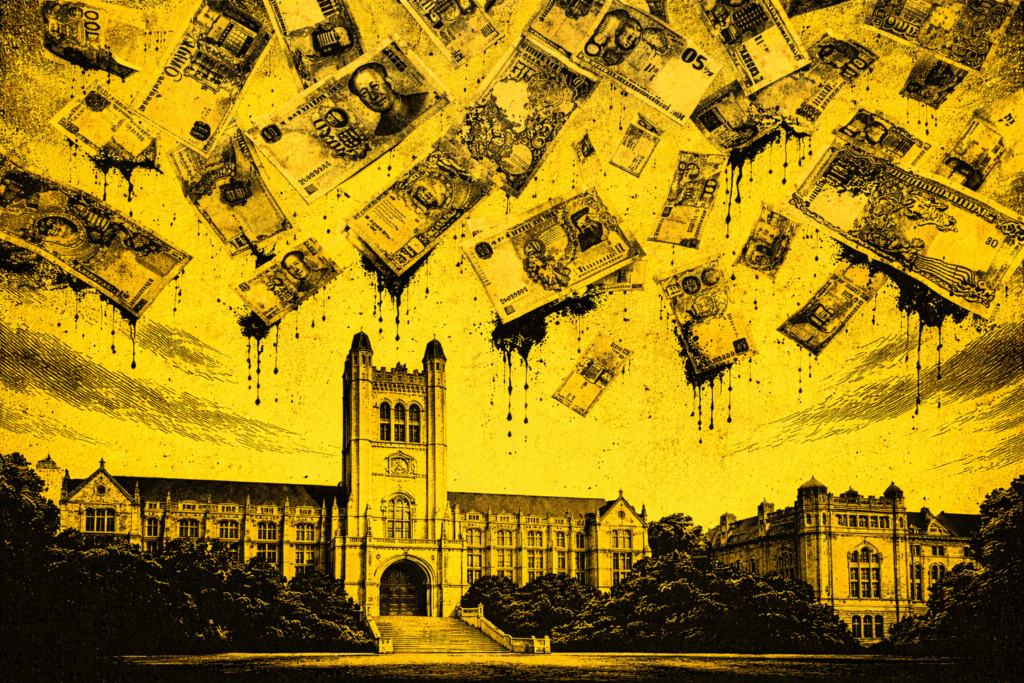
Foreign money does not need to buy conclusions inside American education. It doesn’t need to dictate syllabi, demand loyalty statements, or issue marching orders. It only needs to buy permanence. Endow a chair, fund a center, subsidize curriculum development, and over time the worldview embeds itself quietly, institutionally, and defensibly.
This is about the paper trail that confirms that process exists.
Not a leak. Not a whistleblower. Not a theory.
A federally mandated disclosure regime that almost no one reads.
It’s called Section 117.
A Law That Admits the Risk Without Naming It
Section 117 of the Higher Education Act requires American colleges and universities to report large foreign gifts and contracts to the federal government. Specifically, institutions must disclose any foreign contribution exceeding $250,000 to the Department of Education.
That fact alone matters more than most of the surrounding debate. Congress does not impose disclosure requirements accidentally, and it does not single out foreign funding for special treatment unless it already understands that something is at stake. Section 117 exists because lawmakers recognized long ago that large-scale foreign financing of U.S. universities is not value-neutral. It carries strategic, ideological, and political implications whether donors frame it that way or not.
If foreign funding were harmless, there would be no special reporting threshold.
If it were irrelevant, there would be no law at all.
If it posed no systemic risk, it would be treated like any other donation.
Instead, it occupies a separate category: foreign, tracked, disclosed, and quietly set aside. That contradiction is not an accident. It is the story.
What Section 117 Actually Is
In theory, Section 117 offers transparency. In practice, it offers something far more revealing: a glimpse into how influence survives oversight by being procedurally dull.
The Department of Education publishes sprawling datasets cataloging foreign gifts and contracts reported by universities. They span decades, cover hundreds of institutions, and are technically public. Anyone can download them. Almost no one does.
The reason becomes obvious within minutes of opening the files. The data is messy to the point of discouragement. Entries vary wildly in format and detail. Some identify donor countries; others list vague regions. Some describe restricted gifts with minimal explanation; others provide no purpose at all. Reporting standards change over time, corrections appear years later, and negative dollar amounts surface without context.
None of this is illegal. All of it is compliant. And taken together, it produces a disclosure system that technically satisfies transparency requirements while remaining functionally unreadable.
Foreign funding is not hidden. It is procedurally invisible.
Why the Mess Matters More Than the Numbers
It would be a mistake to treat this chaos as bureaucratic incompetence. The fragmentation serves a purpose. When data cannot be easily aggregated, patterns remain abstract. When purposes are vaguely defined, scrutiny dissolves into speculation. When reporting is self-policed and inconsistently structured, accountability becomes optional rather than mandatory.
Universities often respond to criticism by arguing that Section 117 data is misunderstood or misused by outsiders. That defense misses the point entirely. The problem is not that the data is being misread. The problem is that it is designed in a way that discourages reading at all.
Opacity here does not protect nuance. It protects permanence.
The Government Already Knows This Matters
Another contradiction sits at the heart of Section 117. The federal government clearly treats foreign funding in higher education as sensitive. That is why the reporting requirement exists in the first place. Yet the same system ensures the disclosures are never synthesized into a coherent national picture.
There is no centralized analysis. No systematic donor-to-program mapping. No automatic review for national-security implications. No meaningful consequence for institutions that provide minimal clarity. Compliance is enough. Interpretation is optional.
The result is a disclosure regime that acknowledges risk while structurally preventing it from becoming actionable. That is not a failure of transparency. It is a successful containment of attention.
What Appears When Someone Actually Looks
On the rare occasions when journalists or researchers do the work Section 117 quietly discourages—cross-referencing donors, institutions, timelines, and academic programs—a pattern becomes visible. Foreign funding concentrates not around neutral scientific infrastructure, but around fields that shape interpretation rather than invention: area studies, language programs, cultural institutes, endowed chairs, curriculum development, and teacher training pipelines.
These are not one-time gifts. They are durable investments. They do not require ideological enforcement because they do not need to. Once embedded, they become part of the institution’s internal logic, defended by process, credentialed by peers, and normalized by repetition.
The most effective influence is the kind that stops looking foreign.
Why This Is a National-Security Question
Education is no longer merely an institution. It is infrastructure. It shapes elite formation, bureaucratic staffing, media norms, NGO ecosystems, and policy reflexes over decades. Every other sector with that level of influence is treated accordingly by the national-security apparatus. Education remains an exception, not because it is less powerful, but because it is culturally protected.
Section 117 quietly admits that exception is unsustainable.
The law exists because someone already understood that foreign money flowing into American education carries consequences beyond philanthropy. What remains unresolved is whether the government is willing to treat its own admission seriously.
The Tell, Revisited
The most revealing thing about Section 117 is not any single donor or institution. It is the existence of the ledger itself. The federal government already knows this matters. It simply has not decided to act like it does.
Until that changes, foreign funding will continue to shape American education not through persuasion or coercion, but through endurance. Not by arguing ideas, but by becoming the institution that teaches them.
Section 117 is the map.
The only remaining question is who is willing to read it.
SOURCES:
- U.S. Department of Education (FSA Partners) – “Section 117 Foreign Gift and Contract Reporting: Section 117 Foreign Gift and Contract Data” (n.d.)
- U.S. House Committee on Oversight and Accountability – “Letter to Hochul re: Malign Influence in NYC Schools” (2025)
- ISGAP – “FTM Georgetown Report” (2025)
- Middle East Forum (Campus Watch) – “Qatar Foundation Funding for U.S. Public Schools: A Cause for Concern” (n.d.)
- JNS – “Study doesn’t show Arab donations to universities cause antisemitism” (2025)