
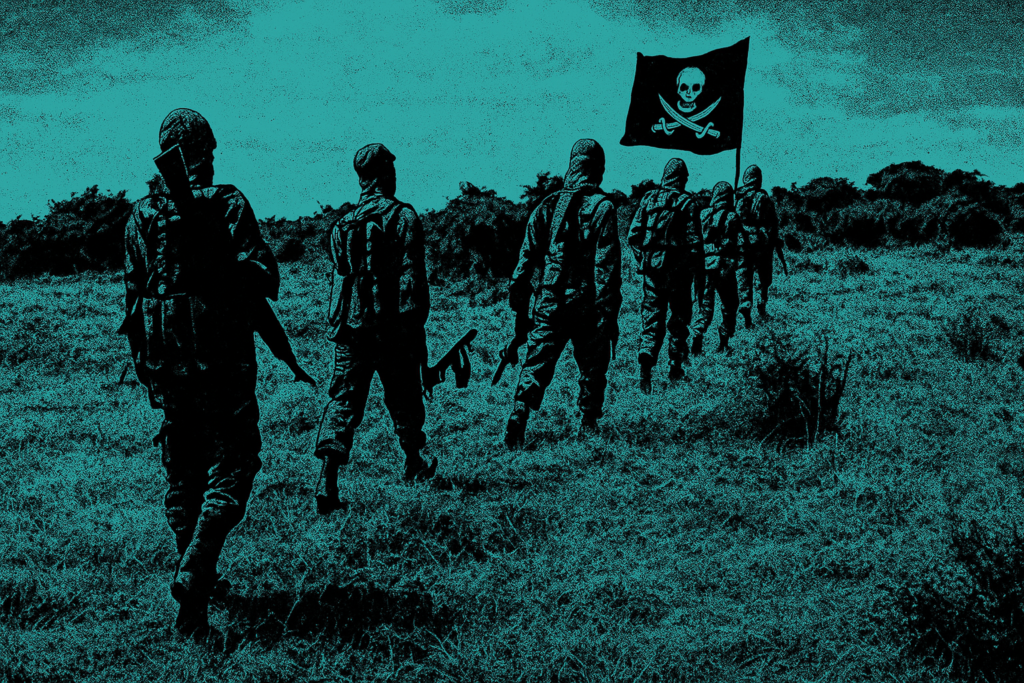
Al-Shabaab: The Junior-Varsity Jihad That Keeps Somalia Hostage. Small-time thugs with big-time body counts, a protection racket pretending to be a caliphate.
You don’t have to romanticize jihad to understand al-Shabaab. You just have to think like a shakedown crew that discovered religion makes a great invoice template.
On paper, al-Shabaab is Somalia’s most dangerous militant group: an al-Qaeda affiliate that controls territory, stages mass-casualty bombings, and terrorizes civilians from Mogadishu tea shops to Kenyan buses. The UN Security Council still describes it as “the most significant threat to the peace and security of Somalia,” and Western intelligence agencies treat it as a serious regional menace.
In practice, it looks less like ISIS 2.0 and more like a brutal, corrupt, permanently broke HOA from hell — the kind of outfit that can murder dozens of innocent people in an evening, but still can’t manage basic governance without stealing from every farmer, truck driver and shopkeeper in sight.
When Barack Obama famously dismissed ISIS as the “JV team,” he was wrong about ISIS. If he needed a real junior-varsity example, he could have pointed to this crew.
Who They Are: From “Islamic Youth” to Permanent Protection Racket
Al-Shabaab (“the Youth”) grew out of the radical wing of Somalia’s Islamic Courts Union in the mid-2000s, turning itself into an insurgent army after Ethiopia — with U.S. support — intervened against the ICU in 2006–2007. The group formalized its allegiance to al-Qaeda in 2012, and Washington has designated it a Foreign Terrorist Organization, hit it with sanctions, and targeted its leadership with airstrikes and special operations ever since.
Its stated goal is simple and maximalist: topple the Federal Government of Somalia, expel foreign forces, and build a “Greater Somalia” under strict Islamist rule, uniting ethnic Somalis from across the region.
But the way it actually pays the bills would be familiar to any mob accountant.
How They Survive: Taxation, Extortion and “Religious” Protection Money
Al-Shabaab today is less an army in the classic sense and more a hybrid of insurgent militia, secret police and predatory tax authority.
- In Mogadishu alone, the group extracts forced “zakat” (charity) and business levies on imports, real-estate deals and everyday commerce, generating well over $100 million a year according to independent estimates, with roughly a third of that coming from the capital city’s economy.
- A detailed European analysis describes a “sophisticated extortion system” where businesses that don’t pay face threats, bombings, kidnappings or worse — al-Shabaab’s version of a late fee.
This is not an organization building a functioning “Islamic state.” It’s a mafia with hadiths stapled to the ledger.
The UN’s own reporting notes that al-Shabaab has proven remarkably resilient, surviving years of offensives by Somali forces and African Union missions by retreating, regrouping, cutting deals with local clans and cranking the extortion machine harder. The result is a paradox: a group strong enough to terrorize the country, too weak and too corrupt to run it.
What They Actually Do: Mass-Casualty Terror and Child Recruitment
“JV” doesn’t mean harmless. It means reckless and sloppy in a way that destroys far more than it can ever build.
Recent reporting on Somalia’s security landscape shows al-Shabaab continuing to:
- Carry out complex, high-casualty attacks in Mogadishu and regional capitals, using suicide bombers, vehicle-borne IEDs and armed assaults on hotels, restaurants and government facilities. One EU-cited dataset recorded more than 160 attacks on civilians in Mogadishu alone across the last reporting period, including hotel sieges and bombings that killed dozens at a time.
- Systematically recruit and abduct children. UN monitoring found more than 900 children recruited and 663 abducted by al-Shabaab in 2022, with no evidence those patterns have improved since.
That’s the core of the group: men who can’t build a modern country, but know how to strap explosives to a teenager and call it piety.
Territory and “Governance”: ISO-Certified Misery
On maps, al-Shabaab’s footprint looks impressive. It maintains influence or control across wide stretches of rural Somalia — especially in central and southern regions — and conducts regular attacks in Mogadishu despite ongoing offensives.
In reality, its “governance” is a grim combination of:
- Forced courts: Sharia “courts” that hand down brutal punishments and summary executions, often resolving disputes in the group’s favor or favoring those who pay.
- Predatory taxation: Farmers, herders and traders pay “zakat” to al-Shabaab on pain of violence; refusing to pay can mean having your land seized, your livestock confiscated, or your relatives abducted.
- Security through fear: Any sign of cooperation with the Somali government or foreign forces — even perceived — can mark a person as an enemy and “legitimate target” in the group’s eyes, according to refugee and human-rights assessments.
The result isn’t an Islamic renaissance. It’s a hostage economy. People pay because they have to, not because al-Shabaab offers a better future.
The Regional Picture: A Local Menace with Limited Range
Regionally, al-Shabaab’s ambitions have always outrun its actual capabilities.
The group has hit targets in Kenya and Uganda — including the 2010 bombings in Kampala and the 2013 Westgate mall attack in Nairobi — and continues to threaten foreign troops and peacekeepers. But its operations remain heavily concentrated in Somalia itself, where it lashes out at government forces, AU missions, and civilians in a grinding war of attrition.
Recent conflict-tracker analysis shows a familiar pattern:
- Somali forces, backed by AU and U.S. support, launch offensives, retake towns, and kill senior militants.
- Al-Shabaab responds with spectacular attacks — suicide bombings on military bases, raids on prisons, ambushes of convoys — to prove it’s still in the game, often forcing federal forces to retreat from newly “liberated” areas a few months later.
UN sanctions panels, Security Council resolutions and regional diplomacy all orbit the same conclusion: this group is a chronic threat, but not a conquering army. It’s persistent because Somalia is weak, not because al-Shabaab is strong.
Money, Again: The “Islamist” Cartel
When you strip away the propaganda, al-Shabaab looks uncannily like a cartel with Qur’anic window-dressing.
- Analyses of the group’s finances point to a robust, decentralized taxation system on trade flows into Mogadishu, checkpoints on roads, livestock markets, ports and border crossings. Businesses budget al-Shabaab “taxes” the way companies in New York budget rent.
- UN and NGO reporting repeatedly point out that these revenues allow the group to survive heavy battlefield losses, bribe local elites, and maintain an intelligence network inside cities it doesn’t even control.
If ISIS tried to be a state and al-Qaeda tried to be a global vanguard, al-Shabaab has settled into being an entrenched, deeply unpopular toll-booth — with bombs.
Why It Matters to the U.S. and the West
From a U.S. or European perspective, al-Shabaab is not the flashiest threat in the global jihad ecosystem, but it is stubbornly durable.
- The U.S. has targeted the group for years with airstrikes, sanctions and counter-terror financing efforts, including high-profile strikes on figures like Maalim Ayman, linked to the 2020 attack on U.S. forces at Kenya’s Manda Bay.
- The UN maintains a dedicated sanctions regime aimed at constraining al-Shabaab’s finances and arms access, even as it lifts long-standing arms restrictions on the Somali government to help it fight back.
- International organizations warn that al-Shabaab’s ability to weaponize drought, famine and displacement — by taxing aid, sabotaging relief and exploiting chaos — compounds every humanitarian crisis in the region.
That’s the quiet reason al-Shabaab keeps showing up in dry, boring intelligence reports: it’s a spoiler. Not powerful enough to remake East Africa, but perfectly positioned to keep it from stabilizing.
The “JV Team” That Won’t Graduate
So is al-Shabaab “dangerous”? Absolutely. It murders civilians, recruits children, destabilizes governments, and keeps tens of millions of people living in fear.
Is it “elite”? No. It’s a violent underachiever — a group that has spent nearly two decades blowing up hotels and tea shops in a country that desperately needs engineers, doctors, and builders.
If Obama needed an example of a junior-varsity jihad, the JV team that never gets promoted, he could have pointed here: to a movement that:
- survives by taxing the people it claims to defend,
- calls extortion “zakat,”
- answers every political problem with a bomb,
- and still can’t offer Somalia anything resembling a functioning state.
They are lethal, yes. But in the long run, they’re not the future of Somalia or of Islam. They’re a cautionary tale with AK-47s — a reminder that when politics, foreign meddling and state failure leave a vacuum, the first thing that crawls out is rarely the “A-team.”
Citations
- Council on Foreign Relations – “Al-Shabab” (Updated 2024)
- Council on Foreign Relations – Global Conflict Tracker: Al-Shabab in Somalia (Accessed 2025)
- Congressional Research Service – Al-Shabaab (IF10155) (August 19, 2024)
- Office of the Director of National Intelligence – Annual Threat Assessment of the U.S. Intelligence Community (2025)
- CIA World Factbook – Somalia (Accessed 2025)
- CIA World Factbook – Terrorist Organizations Reference (Accessed 2025)
- Long War Journal – Al-Shabaab Tag Archive (Ongoing coverage)
- European Union Agency for Asylum – Somalia: Al-Shabaab Control, Presence, and Influence (May 2025)
- Global Initiative Against Transnational Organized Crime – “Disrupting Al-Shabaab’s Hold on Mogadishu’s Economy” (April 24, 2025)
- International Crisis Group – “Somalia: Al-Shabaab — It Will Be a Long War” (June 26, 2014)
- United Nations Security Council – Somalia Sanctions Regime / Panel of Experts Reports (Multiple years)
- Reuters – “Al Shabaab captures strategic Somalia town as it presses offensive” (April 16, 2025)
- Reuters – “Al Shabaab battles Somalia’s army for control of strategic military base” (April 24, 2025)
- FactCheck.org – “Obama Fumbles ‘JV Team’ Question” (September 8, 2014)
- ABC News – “ISIS 2 Years Later: From ‘JV Team’ to International Killers” (June 29, 2016)
- U.S. Department of State – Rewards for Justice: Al-Shabaab (Accessed 2025)
Pingback: Keith Ellison: The Interface Problem - #TCOT Reporter
Pingback: Ports, Factors, and Prize Agents - #TCOT Reporter
Pingback: A Sanctuary for Disorder - #TCOT Reporter